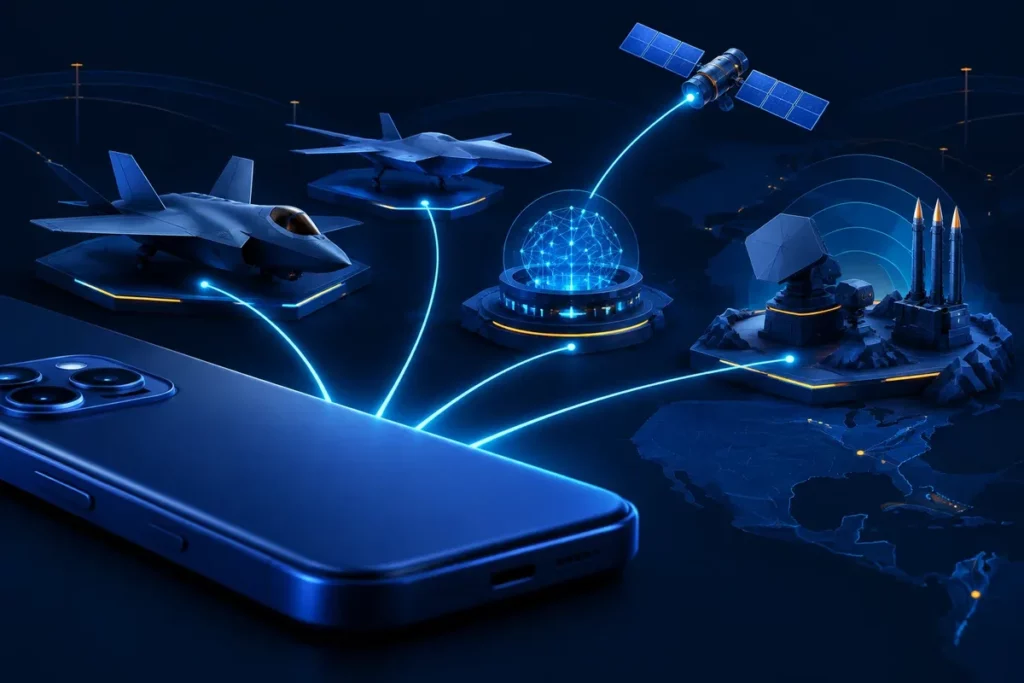
Before you dial, the clearest answer is not one secret weapon but a connected U.S. military ecosystem, with the F-35 as its most visible operational symbol. There is no single objectively most advanced U.S. military technology. The strongest candidates combine artificial intelligence, autonomous systems, precision and hypersonic weapons, layered missile defense, counter-drone systems, cyber operations, advanced sensors and networked command systems, while their maturity ranges from operational capability to prototype and future concept.
The F-35 is the strongest single operational candidate because it joins low observability, sensor fusion, electronic warfare, computing and secure data links in one fielded platform. The broader answer is more demanding: the United States gains technological advantage when aircraft, ships, satellites, command centers, weapons and human operators continue exchanging useful information under attack.
| 🛩️ | Leading fielded platform: The F-35 combines stealth, sensing, electronic warfare and data sharing. |
| 🧠 | Most advanced overall capability: A resilient network linking sensors, commanders, platforms and weapons across domains. |
| 🚀 | Fastest-moving frontier: Hypersonic strike, autonomous systems, artificial intelligence and collaborative combat aircraft. |
| 🛰️ | Hidden infrastructure: Space systems, protected communications, positioning, missile warning and cyber resilience. |
| ⚓ | Strategic survivor: Submarines remain valuable when air bases, satellites and communications face attack. |
| ⚠️ | Key warning: A demonstration, a development program and an operational system are different claims. |
The best answer is an integrated military system, not a single weapon
Advanced military technology means more than speed or destructive power; it combines survivability, sensing, computing, connectivity, precision, resilience and operational maturity. The F-35 leads among individual operational platforms, while the wider advantage comes from connecting air, land, sea, space and cyber capabilities into one functioning military system.
The distinction matters because a weapon can be technically impressive and still deliver little value if it cannot receive targeting data, survive electronic attack, be maintained at scale or operate with an allied force. A prototype may show extraordinary performance during a controlled test. A fielded system must repeat that performance through training, logistics, software updates and hostile interference.
Military analysts commonly separate technology maturity from military importance. The Technology Readiness Level scale runs from TRL 1 to TRL 9, with TRL 9 representing a system demonstrated successfully in an operational environment under the NASA systems-engineering framework. TRL does not measure whether a system is strategically superior.
Yet maturity alone does not settle the ranking. A mature transport aircraft may be more deployable than a sophisticated experimental weapon, while a less visible communications architecture can determine whether several combat systems work together at all.
- Fielded systems are deployed, maintained and used within established military operations.
- Demonstrated systems have completed tests or exercises but may lack full-scale deployment.
- Development programs are being engineered, assessed or prepared for future service entry.
- Forecast concepts describe possible future capability rather than confirmed operational capacity.
That is why a contractor announcement, a successful demonstration and an operational inventory should never be placed in the same category. The cheap headline breaks once the fielding, maintenance and network conditions are examined.
Why the F-35 remains the leading operational example
The F-35 remains the clearest answer when the question is limited to one advanced, operational U.S. military platform. Its low-observable design, active electronically scanned radar, infrared sensing, electronic-warfare equipment, onboard computing and secure data links are designed to work as a single combat system rather than as isolated components.
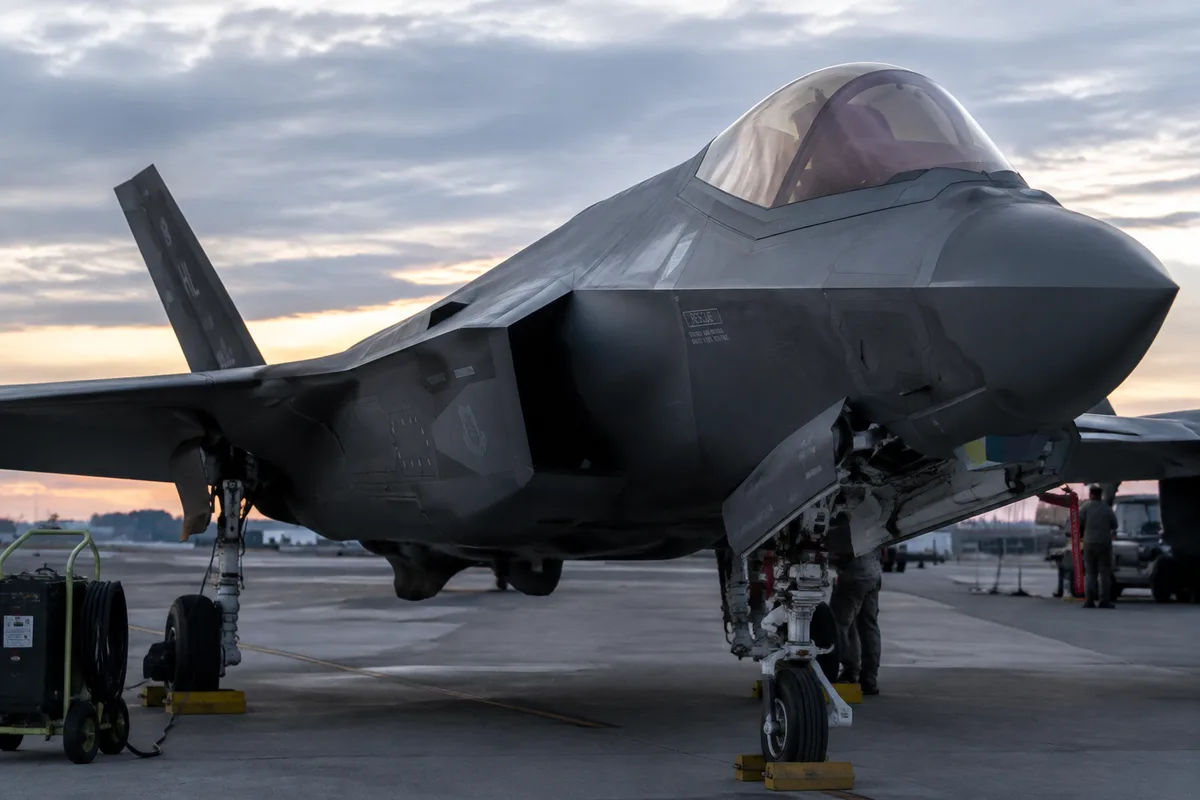
Its central advantage is sensor fusion. The aircraft processes radar returns, infrared observations, electronic signals and external data into a more coherent tactical picture for the pilot and connected forces. This reduces the burden of interpreting separate displays, although the quality of the result still depends on data, software, communications and identification procedures.
Moreover, the aircraft can act as a distributed sensor and targeting node for other aircraft, ships and ground-based systems. An F-35 may detect or classify a threat while another platform contributes the weapon, extending the value of the aircraft beyond its own weapons carriage.
That network role explains why the platform appears in wider discussions of newest military technology in operation. The useful comparison is not simply aircraft against aircraft. It is the nominal mission against the degraded mission after jamming, maintenance delays, weather, software faults or broken communications enter the picture.
Advantages
- Combines low observability with advanced sensing.
- Shares information with connected forces.
- Supports multiple missions from one fielded platform.
- Benefits from a large allied operating ecosystem.
Limitations
- Requires intensive maintenance and software support.
- Creates substantial sustainment and upgrade demands.
- Depends on secure networks and usable data.
- Faces increasingly capable air defenses.
High capability creates high dependency. A sophisticated aircraft needs trained maintainers, spare parts, mission-data updates, secure mission planning and a functioning supply chain. Its price therefore cannot be judged from acquisition alone because availability, upgrades and long-term support affect the operational result.
Air dominance is shifting from aircraft performance to crewed-uncrewed teams
The next stage of U.S. airpower places a crewed aircraft inside a larger team of stealth bombers, autonomous aircraft, sensors and weapons. The B-21 Raider represents long-range penetrating strike and nuclear deterrence, while the Next Generation Air Dominance effort and its F-47 designation point toward a family of systems built around crewed-uncrewed cooperation.
The B-21 is intended to penetrate defended airspace at long range and support the airborne leg of U.S. strategic deterrence. Its importance lies in survivability, range, mission flexibility and integration with intelligence and command networks. Public program descriptions do not justify treating every planned capability as already fielded.
Collaborative Combat Aircraft are intended to expand the number of useful airborne nodes without placing a pilot in every vehicle. Their possible missions include sensing, jamming, decoy operations, missile carriage and risk distribution, although the precise operational mix remains tied to program development and testing.
Thus, autonomous aircraft should be judged by the mission they perform after communications degrade, not by the autonomy label attached to the brochure. An uncrewed platform that cannot receive updated instructions, authenticate data or return safely may impose new burdens instead of creating a dependable advantage.
Check the fallback. A crewed-uncrewed team needs alternate navigation, communications, mission rules and recovery procedures when the primary network is jammed or spoofed.
AI and command networks turn data into battlefield advantage
Artificial intelligence becomes militarily useful when it helps a force process sensor data, prioritize threats, forecast maintenance, plan missions or support decisions faster than human staffs can work unaided. Joint All-Domain Command and Control aims to connect information and effects across military services and operational domains.
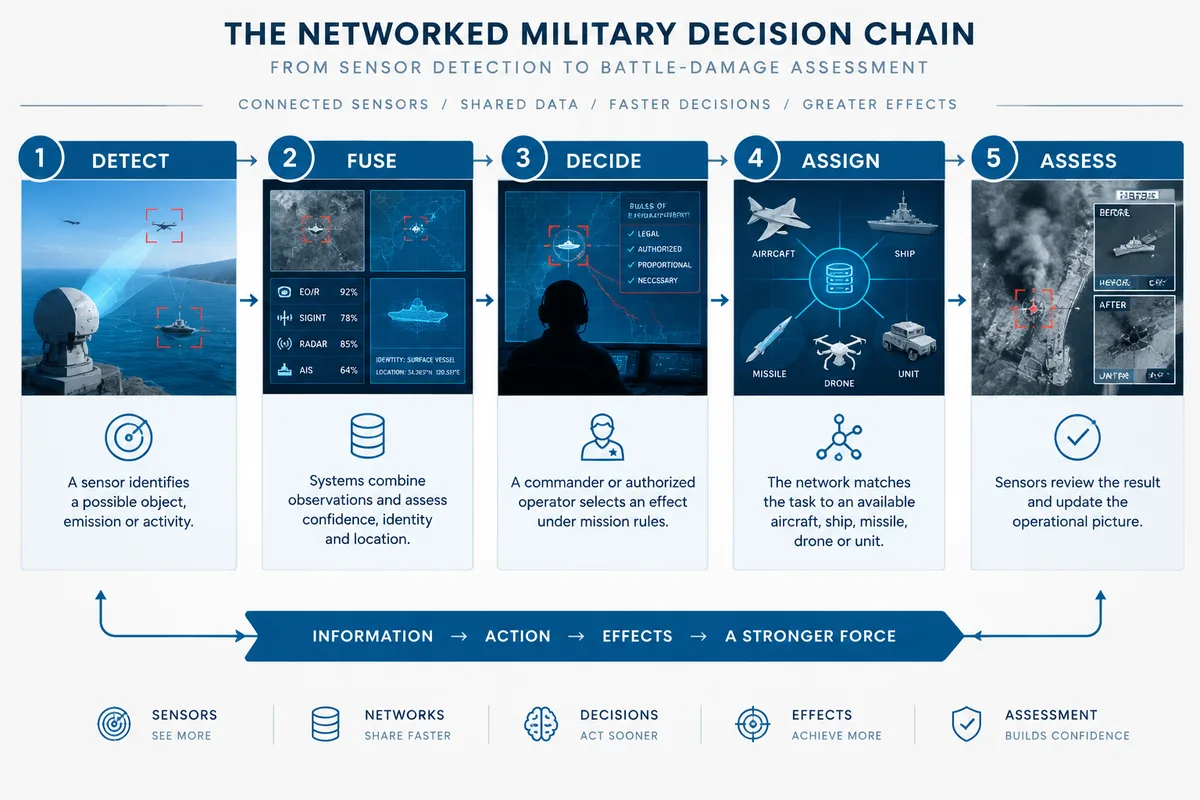
The chain begins with detection and ends with battle-damage assessment. Between those points, data must be fused, confidence must be judged, a commander or authorized operator must decide, and an available weapon or unit must receive a usable task.
That sequence is not automatic victory. Bad sensor data can create a precise answer to the wrong question. Cyber intrusion can alter trusted information. Electronic warfare can delay or distort the handoff, while contested communications can force units to operate with incomplete awareness.
The U.S. Department of Defense framework for autonomous weapon systems is DoD Directive 3000.09, dated January 25, 2023. It addresses autonomy and human judgment requirements; it does not turn artificial intelligence into an independent legal authority to use force.
Meanwhile, the NIST AI Risk Management Framework 1.0 organizes AI risk work through four functions: Govern, Map, Measure and Manage. The NIST Cybersecurity Framework 2.0 uses six functions: Govern, Identify, Protect, Detect, Respond and Recover. These frameworks do not guarantee battlefield reliability, yet they clarify the work required before trusting complex software.
AI is therefore a force multiplier only when data provenance, human authorization, cyber protection and fallback communications are treated as part of the weapon system. Check the fallback. A model that performs well in training can fail when the input environment changes.
Space and cyber systems provide the infrastructure behind advanced weapons
Space and cyber capabilities provide the infrastructure that lets advanced weapons sense, communicate, navigate and coordinate. Satellites support protected communications, positioning, navigation, missile warning, intelligence collection and targeting, while cyber operations defend those connections and may disrupt an adversary’s systems.
Proliferated low-Earth-orbit constellations seek resilience through distribution: many satellites can reduce the effect of losing one node. Distribution does not make a network invulnerable. Ground stations, user terminals, software, radio links and orbital paths remain exposed to interference, attack and congestion.
Cyber power works in both directions. Defensive teams must protect mission systems, logistics, identity controls and software updates. Offensive operations may seek to interrupt an opponent’s communications, sensing or command processes, but public descriptions rarely reveal enough detail to assess operational availability or effectiveness.
Satellite navigation also illustrates the fallback problem. Aircraft, ships, missiles and ground units can use alternative navigation methods, inertial systems or local references, yet those alternatives may be less convenient, less accurate or harder to update during a prolonged disruption.
Readers tracking the wider information environment can compare specialist reporting through defense news from Opex360, while keeping editorial reporting separate from official program status and contractor claims.
And the dependency is industrial as well as digital. Advanced processors, sensors, propulsion components, secure radios and specialized materials require qualified suppliers, protected production knowledge and tested replacement paths.
Hypersonics, missile defense, and lasers redefine the strike-intercept contest
Hypersonic weapons operate at Mach 5 or above, although speed alone does not explain their difficulty. Maneuvering trajectories, heat management, guidance, tracking and compressed decision time can complicate detection and interception across the boost, midcourse and terminal phases of a missile flight.
U.S. hypersonic efforts include the Army’s long-range strike work, the Navy’s Conventional Prompt Strike program and Air Force programs with different mission requirements and development paths. Their public maturity should be separated carefully from forecasts about future performance.
An Army University Press article discussed a 2040 future scenario in which a hypersonic weapon could reach up to 20 times the speed of sound. That is a projection in a future-oriented article, not evidence that every current U.S. hypersonic system reaches that speed or is fully deployed.
Missile defense follows the same logic. Aegis, THAAD, Patriot, sensors, command networks and interceptors form layers aimed at different threats and flight phases. No single shield covers every trajectory, altitude, speed or decoy condition.
High-energy lasers could support counter-drone and short-range air defense because they offer a potentially deep magazine while power is available. Their usefulness is constrained by electrical supply, cooling, atmospheric conditions, range, beam control and the ability to keep a target tracked.
Check the fallback. A defense that depends on one radar, one interceptor type or one communications path gives the attacker a single failure point.
| Capability | Primary purpose | Main constraint |
|---|---|---|
| Hypersonic strike | Compresses warning and reaction time against defended targets. | Guidance, thermal management, tracking and program maturity. |
| Layered missile defense | Combines sensors, command systems and interceptors across flight phases. | Threat diversity, saturation, decoys and limited engagement windows. |
| High-energy lasers | Supports close-range defense against selected airborne threats. | Power, cooling, weather, range and continuous tracking. |
Undersea and nuclear modernization remain strategically decisive
Undersea forces remain among the most advanced U.S. military systems because stealth and endurance preserve options when satellites, air bases and conventional communications are under pressure. The Columbia-class ballistic missile submarine is designed to anchor a future sea-based nuclear deterrent, while Virginia-class attack submarines support intelligence, strike and special-operations missions.
A submarine’s value is difficult to summarize with a public specification. Quiet operation, sonar performance, crew training, endurance, weapons integration and command procedures interact in an environment where detection can determine survival.
The Virginia class combines quiet operation with advanced sonar, cruise-missile capacity, intelligence collection and support for special operations. These missions make the boat a network participant, yet undersea forces also retain value when other parts of the network are disrupted.
Sentinel intercontinental ballistic missiles and the B-21 belong to the wider modernization of the U.S. nuclear triad. The strategic purpose is continuity of deterrence across land, sea and air, rather than a race to identify one universally superior weapon.
However, nuclear systems impose unusually demanding requirements for authorization, communication, security, maintenance and command continuity. Their advanced status comes from survivability and controlled reliability, not from autonomy without human authority.
That is why the most expensive system is not automatically the most advanced. A platform earns strategic value when it remains useful during the degraded scenario, when the expected network is damaged and the opponent is actively searching for its weaknesses.
Which U.S. military technology is most advanced for each definition?
The answer changes with the definition. The F-35 is the best answer for a fielded, multipurpose platform that visibly combines several advanced technologies, while the connected architecture of AI-enabled command networks, space assets, secure communications, sensors and precision weapons is the stronger answer for overall military capability.
For a reader comparing named systems, the following verdict is more useful than a single ranking:
Cost also changes the judgment. Public budget figures can show the scale of defense spending, yet they do not provide a reliable total cost of ownership for each program, including maintenance, upgrades, training, infrastructure and replacement parts. A platform with extraordinary performance may deliver less value if availability remains low.
Industrial bottlenecks create another hidden test. Specialized semiconductors, propulsion components, sensors, secure software and advanced materials may determine whether a system can be produced or repaired at scale. A prototype can avoid those constraints temporarily; an operational force cannot.
For ongoing coverage of new systems, latest military equipment news can help identify announcements, tests and program changes, but each claim still needs a maturity check.
Frequently Asked Questions
What branch of the military has the highest IQ?
No U.S. military branch has an officially recognized highest average IQ. Selection standards differ by role, and technical occupations in every branch may require advanced education, testing and specialized training rather than a single branch-wide intelligence ranking.
Is quantum computing currently a standard operational capability of the U.S. military?
No publicly confirmed evidence shows quantum computing is a standard operational capability across the U.S. military. Research focuses on potential uses such as optimization, secure communications, sensing and cryptanalysis, but these applications remain distinct from widespread field deployment.