Before you search, the spelling matters: OpenX360 usually refers to Opex360, a French specialist news website covering defense, military affairs, equipment, procurement, operations, strategy, and related geopolitics. It is useful for defense monitoring and context, but important figures, contracts, budgets, and schedules should be checked against official or primary sources.
The site is associated with the Zone Militaire editorial identity and focuses on French defense policy while following international military developments when they affect security, alliances, technology, or geopolitics. Its value is strongest when a reader follows a subject across several articles rather than treating one headline as the complete record.
En bref
Correct name: Opex360 is the spelling used by the website; OpenX360 is a frequent search variant.
Editorial focus: French defense, armed forces, procurement, operations, equipment, and security policy.
International scope: Foreign conflicts, alliances, strategic competition, and European defense when relevant to France.
Best use: Specialist monitoring and context, followed by verification of decisive claims in official or primary sources.
Main caution: An intention, signed contract, delivery, and operational capability are different milestones.
OpenX360 and Opex360: the name, site and editorial identity
Opex360 is the website’s established spelling, while OpenX360 is a common search variant created by similar pronunciation and letter patterns. The publication is associated with Zone Militaire and focuses on defense, military affairs, security, operations, and the defense industry for a French-speaking audience.

Why the two names are confused
Searchers who type OpenX360 are generally looking for Opex360. The distinction is practical: using the Opex360 name and the official Opex360 website reduces the risk of landing on an unrelated military, technology, or security page.
Opex360 reportedly began in 2007, although that historical claim should be read as a dated website-history reference rather than proof of its current editorial status. A 2017 IRSEM survey was also reported as placing it among three major French defense blogs at that time. These historical markers provide context, but they do not establish a current ranking.
Its legal notices and editorial information establish the publishing framework, while visible bylines, article dates, archives, and recurring subject areas show how the publication operates in practice. The site’s contact information identifies Laurent Lagneau as editor and provides a contact form and the address zone.militaire@gmail.com; the form requires a pseudo and an email address.
What does Opex360 cover, from French forces to strategic competition?
Opex360 primarily covers French armed forces, military operations, procurement, equipment, readiness, defense policy, and strategic affairs. It also follows international conflicts and alliances when they matter to France or Europe. Its editorial perimeter is therefore French-centered rather than exclusively domestic.
Operations, units and military capabilities
Reporting can involve the Army, Navy, Air and Space Force, special operations, overseas forces, and joint missions. Articles may connect an operational event with ammunition stocks, aircraft availability, training cycles, force modernization, or the practical limits of a capability.
A platform appearing in an announcement does not automatically mean that it is available, deployable, or ready for a specific mission.
- French deployments and overseas missions
- Exercises, readiness, personnel, and force structure
- Aircraft, ships, armored vehicles, missiles, drones, and space systems
- Air defense, deterrence, logistics, and joint operations
Industry, contracts and major programs
Opex360 follows defense programs from public announcements through contracts, deliveries, upgrades, delays, exports, and capability consequences. This makes it useful for readers tracking manufacturers and programs, although the headline date rarely represents the date when a usable military capability enters service.
For broader context, readers researching latest military equipment news can compare a program announcement with later delivery or deployment reporting.
Geopolitics through a French defense lens
International conflicts, NATO decisions, European defense, deterrence, and major-power competition appear through their implications for France and Europe. Coverage may include foreign military developments, yet the editorial question often remains national: what does this mean for French forces, industry, policy, or security?
Official statements, reported developments, analysis, and opinion carry different evidentiary weight. Read the attribution before accepting the conclusion.
How does Opex360 turn defense developments into daily coverage?
Opex360 combines rapid reporting on announcements and events with contextual articles about programs, parliamentary decisions, military capabilities, and strategic consequences. Article dates, follow-up coverage, categories, archives, tags, and internal links help readers reconstruct how an initial announcement develops over time.
One announcement can contain several separate claims. A government release may describe an intended capability. A company statement may emphasize a contract or industrial milestone. A later article may clarify delivery timing, training, funding, or deployment. The operational result can arrive years after the political announcement.
The strongest reading method is chronological, not headline-driven. Start with the current article, identify the institution or company named, then inspect earlier and later coverage of the same program, unit, operation, or decision.
- Record the article date and the named actors.
- Separate confirmed facts from attributed claims.
- Find the underlying ministry, parliamentary, company, or institutional document.
- Search for a later delivery, budget, contract, or deployment milestone.
Categories and archives are especially useful when a subject has changed names or passed through several procurement stages. A single article may explain the event; the archive shows whether it became a decision, a funded program, a delivered system, or an unresolved announcement.
How reliable is Opex360 for defense news?
Opex360 is useful as a specialist reporting source for French military activity, official announcements, procurement developments, and defense-industry news. It should not be treated as the sole authority for a budget, contract, delivery schedule, or battlefield claim when an official or primary document can establish the underlying fact.
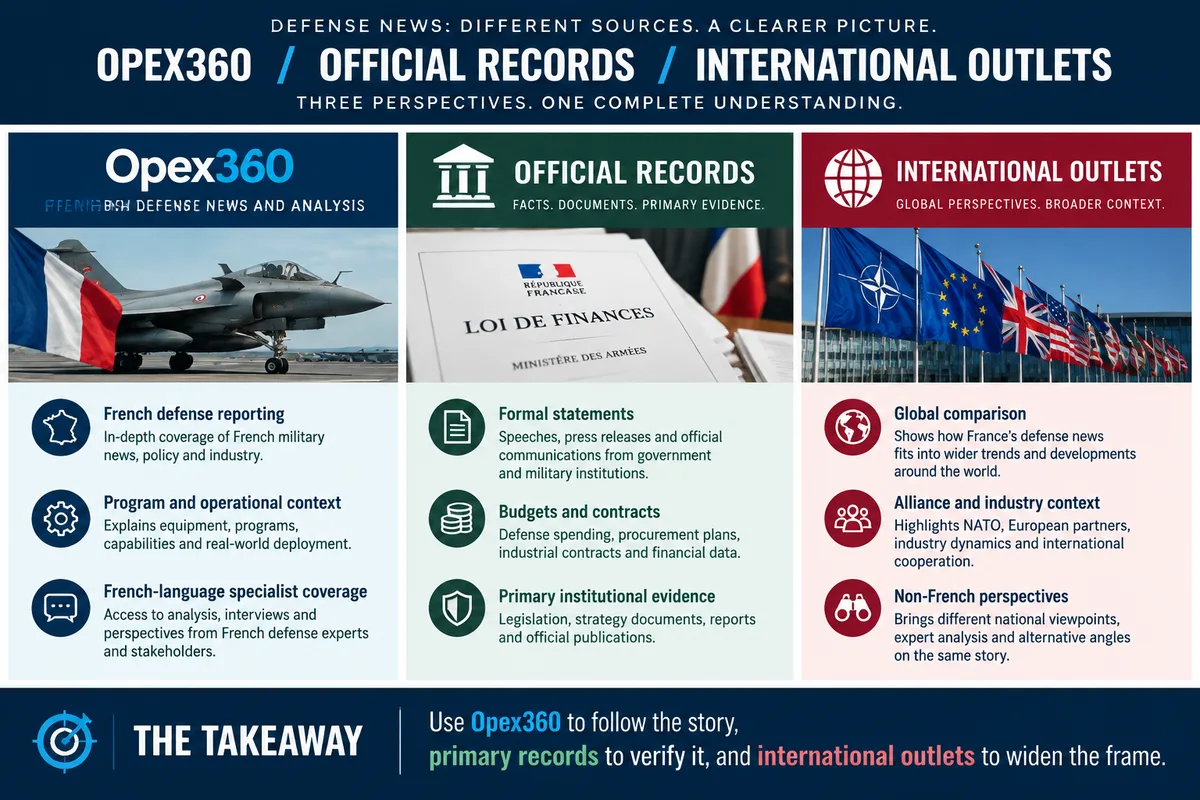
Use Opex360 for monitoring and primary records for decisions. A signed contract has a different status from a political intention, while a delivery milestone has a different status from an announced order.
Reading claims at the right level of certainty
Look for publication dates, named sources, direct documents, attributed statements, and later updates. These details show whether an article reports a confirmed event, relays a claim, interprets a policy choice, or describes an emerging development that may later be refined.
Early information can be incomplete. Initial reporting may describe what officials, companies, or operational sources say before the financial, legal, or technical record is fully available.
| Claim type | What it establishes | What to verify |
|---|---|---|
| Political intention | A stated direction or objective | Budget approval, legal decision, and implementation |
| Budget announcement | A planned or proposed allocation | Final appropriation and spending execution |
| Signed contract | A formal industrial or procurement commitment | Scope, options, delivery schedule, and cancellations |
| Delivery milestone | Transfer of equipment or a production stage | Training, acceptance, availability, and deployment |
| Operational report | An account of an event or activity | Attribution, independent confirmation, and later updates |
If a primary link is unavailable, use the article date, named institution, company, and program identifier to locate the underlying public record.
Opex360’s France-centered perspective is both useful and limited. It gives sustained attention to French institutions and programs, while international specialist sources can add allied, industrial, or regional perspectives.
Opex360 compared with other defense information sources
Opex360 offers sustained French-language coverage of French forces, domestic programs, and national defense debates. International specialist outlets broaden the view of global procurement and alliances, while official channels provide primary statements. The strongest monitoring approach combines all three.
| Source type | Best use | Limit | Reader decision |
|---|---|---|---|
| Opex360 | French defense reporting and context | France-centered editorial lens | Use for specialist monitoring |
| Official ministry or military channel | Statements, releases, and formal announcements | Limited independent scrutiny | Use to verify primary claims |
| Parliamentary or budget document | Funding, policy, and program records | Technical and slower to interpret | Use for financial and legal grounding |
| International specialist outlet | Allied, foreign, and global industry context | Less detail on French institutions | Use to test the wider picture |
| General news outlet | Accessible background and major events | Usually less program depth | Use for broad public context |
Where Opex360 is strongest
Its recurring attention to French capability programs and institutions helps readers follow stories that general news media may mention only briefly. French-language reporting also preserves national terminology, institutional references, and domestic defense-industry context.
For an international comparison, readers can consult military news sources explained without treating any single outlet as complete.
Where complementary sources add value
International outlets place French programs beside allied, competing, and export-market alternatives. Parliamentary and budgetary records provide the underlying trail for policy, spending, and procurement decisions.
How to use Opex360 for ongoing defense monitoring
Readers can follow a recurring subject by pairing the latest Opex360 report with older articles, linked documents, and subsequent updates. This works especially well for French-speaking professionals, students, journalists, defense enthusiasts, and researchers who need continuity rather than a single news alert.
A practical cross-source routine
Begin with the newest relevant report. Identify the program, operation, unit, company, or institution, then locate the corresponding primary document and compare it with an independent international account.
When translation is needed, use it to understand the article, then verify names, dates, figures, and technical terms against the original source.
- Separate immediate news from confirmed milestones.
- Track the same subject across dates and article updates.
- Mark whether each statement comes from officials, industry, parliament, or the publication’s analysis.
- Recheck schedules after delays, budget changes, or revised announcements.
FAQ
How should an Opex360 article be cited in academic or professional work?
Cite the named author, article title, Opex360, publication date, URL, and access date. If no individual author is listed, use Opex360 as the corporate author. If the article shows both publication and update dates, record both.
How should French defense acronyms from Opex360 be presented in an English report?
Write the French name in full at first mention, followed by the original acronym and an English explanation in parentheses. Keep the original acronym in later references so the program or unit can be matched to French institutional records.
What is the difference between an Opex360 article’s publication date and the date of the event it describes?
The publication date identifies when Opex360 reported the information, while the event date identifies when the decision, operation, delivery, or announcement actually occurred. Record both dates when documenting a defense development.