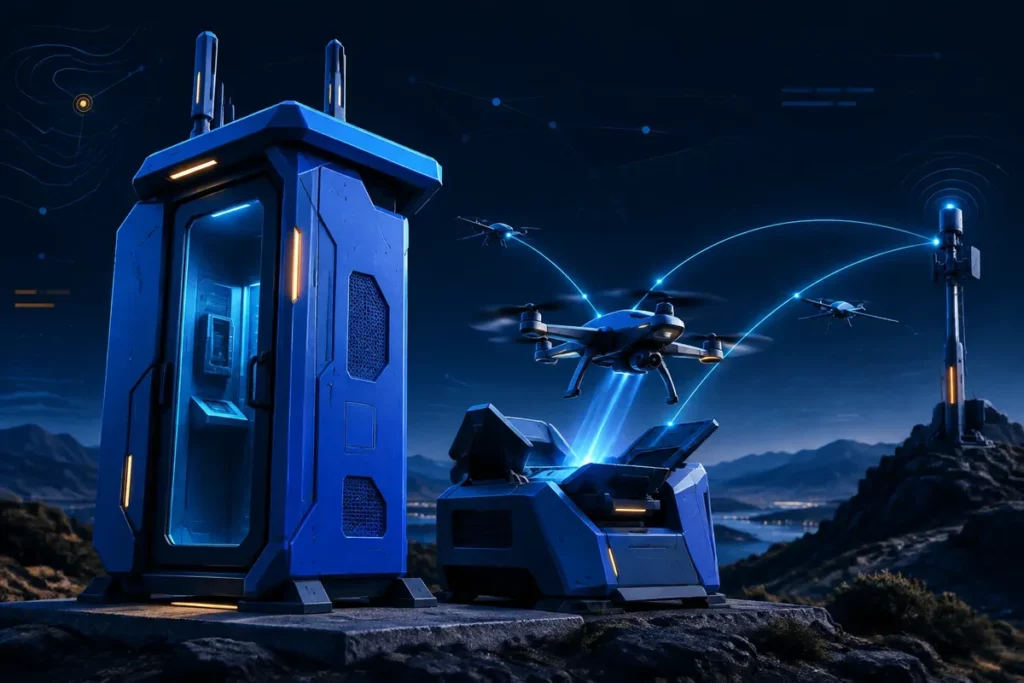
Before you dial, the most useful answer is this: the supplied public material does not establish a fully verified ranking of the newest military technologies currently in operation. AI-enabled drones, networked uncrewed systems, electronic warfare, hypersonic weapons, directed-energy defenses, advanced aircraft, cyber tools, and networked sensors all appear in current reporting, yet several examples remain future programs, proposals, or tests.
The strongest practical answer is AI-enabled, networked uncrewed technology because it is being deployed, adapted, countered, and updated in active military environments. A newly commissioned strategic weapon may be newer on paper, while a simpler drone ecosystem may have greater operational impact. The distinction matters. A headline is not a handoff to service units.
| 🧭 | Best overall answer: AI-enabled and networked uncrewed systems show the clearest combination of novelty, field use, and rapid operational adaptation. |
| ⚙️ | Operational meaning: A capability must be fielded to military units and used for missions, training, deterrence patrols, or combat tasks. |
| 🚁 | Leading examples: First-person-view drones, loitering munitions, reconnaissance UAVs, and coordinated uncrewed operations. |
| 📡 | Hidden enablers: Electronic warfare, resilient communications, sensor fusion, software, and counter-drone networks often determine whether platforms work. |
| 🚀 | Strategic alternative: Hypersonic weapons and advanced missile systems may qualify when “newest” means the latest formally declared high-end capability. |
| ⚠️ | Main warning: Procurement announcements, demonstrations, prototypes, and planned deliveries do not prove current operational service. |
What counts as military technology currently in operation?
Currently operational military technology has crossed from demonstration into an organized military capability. It belongs to a unit, has an assigned mission, fits a command structure, and can be supported through training, maintenance, communications, and supply arrangements rather than existing only as a prototype or procurement announcement.
Operational status has levels. Initial operational capability usually means that a force can perform a defined mission with an early fielded capability. Limited deployment means some units possess the system, while broad service adoption indicates a wider and more mature presence.
Full operational capability is a separate claim.
Yet the vehicle is not always the newest part. A software upgrade, autonomous navigation function, machine-supported target-recognition package, or networked command layer can change military capability while the aircraft, ship, or ground vehicle remains familiar.
The evidence should identify four items together: the system, the operator, the claimed status, and the date. A manufacturer announcement alone cannot establish that combination. An official service declaration is stronger, while repeated independent observation of field use adds a different kind of evidence.
- Operational: fielded and assigned to a military mission.
- Limited operational use: deployed or used by selected units, with restricted scale or availability.
- Testing: evaluated under controlled or developmental conditions.
- Procurement: ordered, funded, or contracted without proof of current mission use.
- Future or conceptual: announced, proposed, or designed for later service.
Check the fallback. If a source gives only a test result, treat the system as tested. Where does it fail? The answer is usually at the border between technical availability and military integration.
The strongest candidates: recently fielded systems with operational evidence
AI-assisted drones are the strongest candidates for the newest military technology currently in operation because they combine recent software, autonomous functions, low-cost hardware, networked control, and repeated use in contested environments. Electronic warfare and counter-drone systems belong beside them because they determine whether those aircraft can navigate, communicate, and complete missions.
| Category | Named examples | Operator or users | Operational evidence | Limitation |
|---|---|---|---|---|
| AI-assisted uncrewed aircraft | Reconnaissance UAVs, FPV drones, loitering munitions | Multiple armed forces | Repeated battlefield employment and unit-level adaptation | Jamming, weather, battery life, and human targeting decisions remain decisive |
| Electronic warfare | Jammers, passive detection, software-defined radios | Forces operating in contested electromagnetic environments | Used to disrupt navigation, control links, radar, and communications | Effects vary by frequency, geometry, power, and enemy adaptation |
| Counter-drone defense | Detection, identification, jamming, spoofing, and kinetic interception suites | Ground units and fixed-site defenders | Integrated into protection of troops, vehicles, and installations | No single layer defeats every aircraft, signal, or attack profile |
| Hypersonic weapons | Operationally declared maneuvering or high-speed strike systems | Selected national armed forces | Formal service claims and selected reported employment | Public evidence on reliability, targeting, and interception remains limited |
| Autonomous maritime systems | Uncrewed surface and underwater vehicles | Naval forces and specialist units | Surveillance, mapping, mine-countermeasure, and reconnaissance missions | Endurance, communications, recovery, and sea-state constraints |
| Directed-energy defense | Laser counter-drone and point-defense systems | Selected military users and test units | Limited deployment and operational integration in narrow roles | Line of sight, weather, power supply, and dwell time constrain use |
The table separates repeated military use from public claims. It does not create a universal ranking. A system may be operational in one force while remaining experimental in another, and export versions can have different software, sensors, or rules of employment.
For readers tracking named programs, latest military equipment news can help locate announcements, yet an announcement still needs a status check before it enters an operational list.
AI-assisted aircraft deserve priority because their software cycle is short. Routing, stabilization, object tracking, visual navigation, return-to-home logic, and terminal guidance can be modified without replacing the entire airframe.
But machine assistance does not automatically mean independent lethal decision-making. In many operational arrangements, people select missions, approve targets, set constraints, supervise execution, or retain the authority to abort an engagement.
Hypersonic systems occupy a different category. Public descriptions commonly use Mach 5 as a threshold, although wording varies between “exceeding Mach 5” and “Mach 5 or greater.” Speed alone does not establish operational maturity.
Directed-energy systems are also easy to overstate. A laser that can damage a drone under controlled conditions may still face cloud, rain, dust, obscuration, power, tracking, and line-of-sight limits in an operational setting.
Check the fallback. If the primary control link is jammed, the system needs another navigation or mission path. That fallback may involve inertial navigation, visual navigation, preplanned routing, autonomous return, or a different communications channel.
Why AI-enabled drones are the leading practical answer
AI-enabled drones lead the practical answer because they are already part of military reconnaissance, targeting, strike, and force-protection workflows, while their software and operating methods continue to change quickly. Their significance comes from scale and adaptation, not from a single spectacular platform or a claim of complete autonomy.
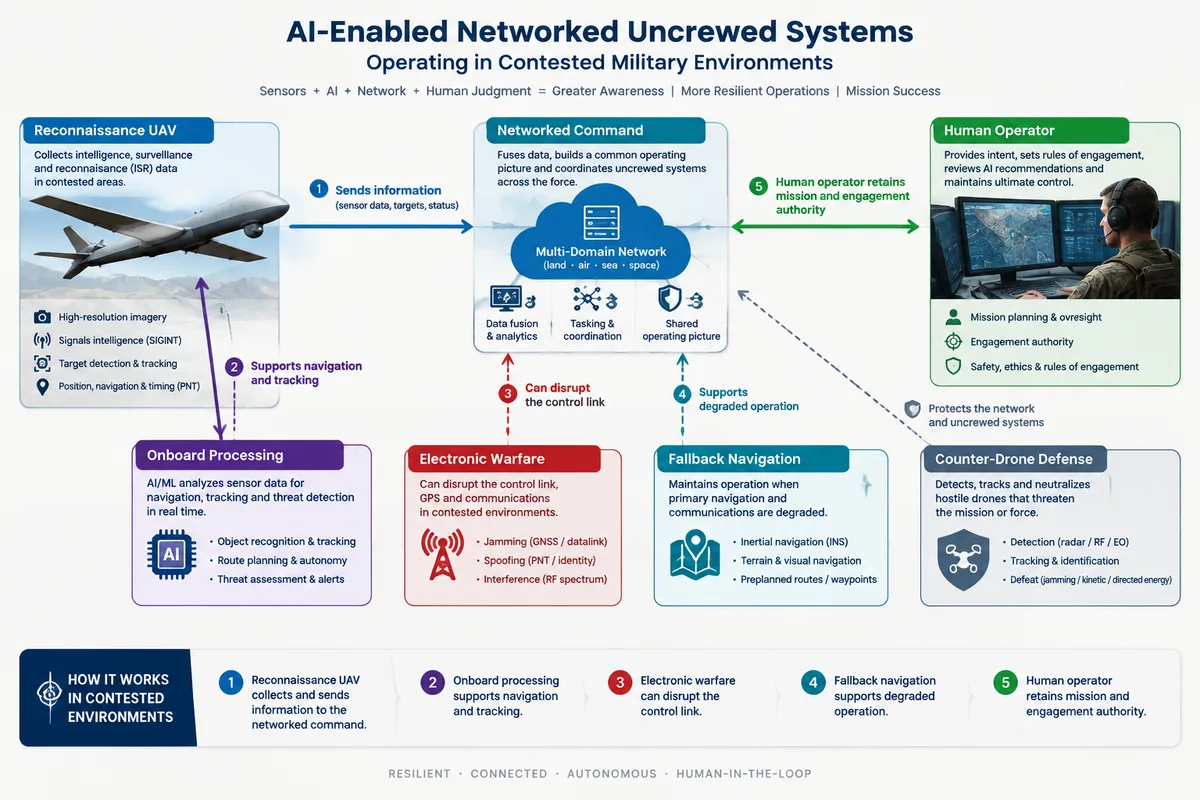
The common battlefield pattern is a chain. A reconnaissance UAV observes an area, a network moves information, an operator or command system evaluates it, and another platform may deliver an effect. The newest element can be the handoff between those functions.
That handoff is fragile. Signal loss, spoofing, terrain, weather, battery depletion, sensor confusion, or a changing target can break the nominal mission path.
Yet the technology remains operationally new when units can alter the system rapidly. A force may change its software, antennas, navigation logic, payload, or launch method after encountering a new countermeasure.
The popular claim that every autonomous weapon operates without human control is incomplete. Automation often handles flight stability, route following, image sorting, object tracking, or terminal guidance. Human responsibility can remain attached to mission selection and engagement authorization.
Rules of engagement matter more than the adjective autonomous. A weapon’s technical ability and the authority permitted to use that ability are separate questions.
Electronic warfare is the stress test. A drone that works through a clean control link may need visual navigation or onboard processing once an adversary attacks its signal. A system with no fallback can be cheap and impressive while remaining operationally brittle.
The same logic applies to loitering munitions. Their value depends on detection, identification, operator judgment, target access, navigation, and terminal performance; the airframe is only one part of the chain.
AI also creates a maintenance problem. Model updates require data, validation, secure distribution, operator training, and a way to reverse a bad release. A faster software cycle increases capability and increases the speed at which an error can spread.
Where does it fail? It fails where the sensor picture, network path, or human authority breaks. That is why an operational assessment must examine the full mission system rather than the drone’s advertised specification.
Other technologies that are new in service, but not equally mature
New operational capabilities differ by mission, deployment scale, and public evidence. Hypersonic weapons may be newer as strategic systems, while electronic warfare, counter-drone defenses, and networked sensors may be more mature in daily use because they support many units and missions.
Hypersonic and long-range strike weapons
Hypersonic weapons are generally described as systems capable of at least Mach 5, with some designs adding maneuvering flight or reduced warning time. Their operational status must be separated from advertised speed, because reliability, payload, targeting, and interception data are rarely public in full.
A weapon can be formally declared operational and still be available only in limited numbers. That matters for comparison.
Reported combat employment should be treated separately from service entry. A public claim may identify use, while independent confirmation of the exact system, mission, and effect remains unavailable.
For current technology tracking, a strategic missile is a stronger answer when “newest” means the latest high-end system declared operational by a military. It is a weaker answer when “newest” means the capability changing daily military practice at meaningful scale.
That distinction excludes future programs such as planned delivery systems or next-generation aircraft from the main answer until an operator confirms fielded use. A program can be technologically impressive and still remain outside current service.
Electronic warfare, counter-drone defense, and battlefield networks
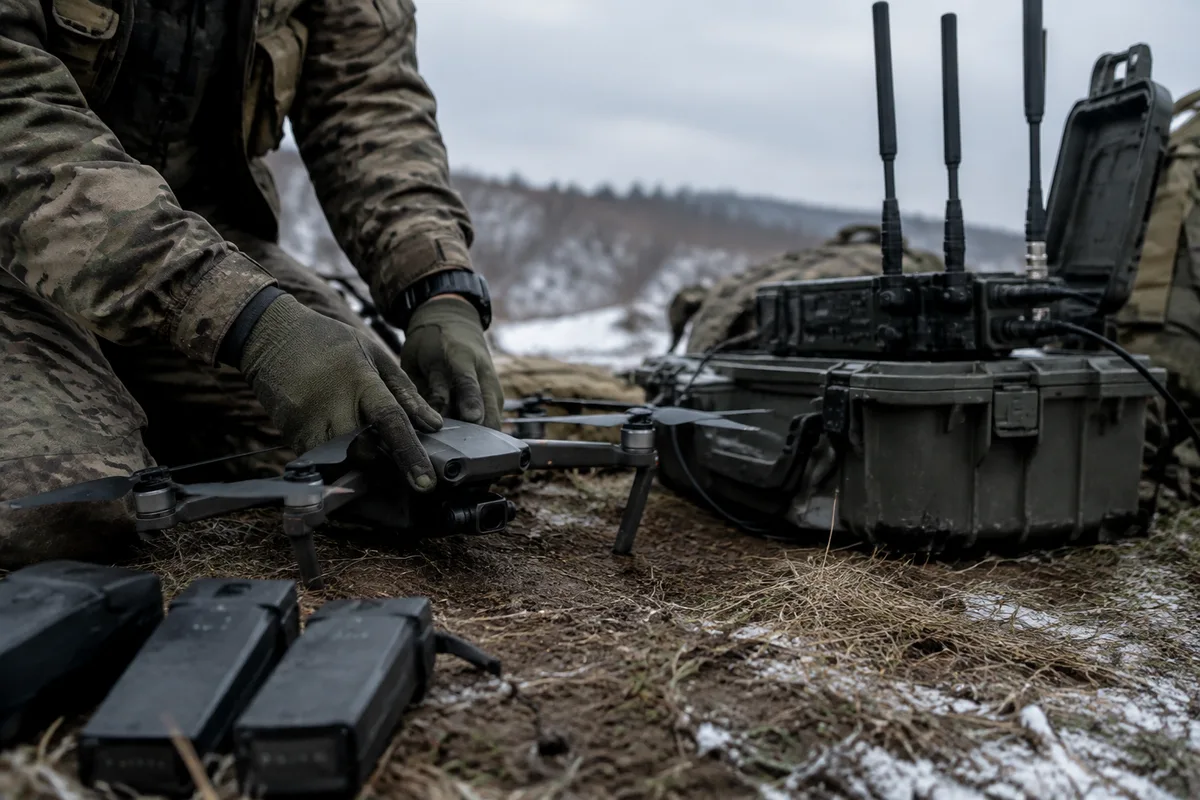
Electronic warfare and battlefield networking are already operational because they affect whether aircraft, artillery, sensors, and command posts can communicate and function in contested electromagnetic conditions. Their newest features may appear as software, firmware, antennas, or integration layers rather than as a new vehicle.
Jamming attacks a signal. Spoofing attempts to mislead a receiver.
Passive detection can locate emissions without transmitting, while resilient communications attempt to preserve the command path under interference. Counter-drone suites may combine detection, identification, jamming, spoofing, kinetic interception, and command integration.
However, no single countermeasure should be treated as universal. Frequency, power, distance, terrain, antenna placement, signal design, and the attacker’s fallback determine the result.
These systems are difficult to date from public announcements. A force may improve its network without publishing a new platform, and a classified software release can alter operational capability without a visible procurement milestone.
Check the fallback. A networked force needs alternate paths for navigation, targeting, and command when the preferred channel is denied.
Directed energy, space-enabled surveillance, and advanced air defense
Directed-energy weapons, satellite communications, space-enabled intelligence, and advanced interceptors have reached different levels of deployment. Their operational value is clearest in narrow roles such as counter-drone defense, point protection, communications, or surveillance rather than in broad claims of battlefield dominance.
Lasers require line of sight and sustained tracking.
Weather, dust, smoke, power generation, cooling, dwell time, and target movement shape the result. A laboratory demonstration therefore cannot stand in for a fielded defensive capability.
Space-enabled communications and surveillance are operationally consequential, yet their newest functions may be upgrades within long-running constellations. The technology is still new in capability terms even when the satellite architecture is not new.
Advanced air-defense systems face a similar issue. A new interceptor, radar mode, or sensor-fusion package can change the defense network while the launcher and command vehicle remain familiar.
Readers looking for the most advanced U.S. systems should separate current service from planned programs in this advanced U.S. military technology overview.
Which technology is newest under each definition?
AI-enabled, networked uncrewed systems are the strongest overall answer when newest means recently evolved technology used at meaningful scale. Hypersonic weapons lead under a narrower definition focused on strategic service entry, while electronic warfare leads when rapid updates and broad effects across existing units matter most.
| Definition of newest | Leading category | Why it leads | Where the claim weakens |
|---|---|---|---|
| Newest with meaningful operational use | AI-enabled uncrewed systems | They combine field use, software change, and rapid adaptation | Public data rarely reveals exact quantities or classified autonomy levels |
| Newest high-end strategic capability | Hypersonic weapons | They represent recent advances in speed, maneuver, and warning-time compression | Public evidence on reliability and combat effect is incomplete |
| Newest force-wide capability | Electronic warfare and networks | Updates can affect many existing weapons and units | The newest release may not be publicly dated or named |
| Newest defensive layer | Counter-drone and directed-energy systems | They respond to a rapidly changing threat environment | Weather, power, line of sight, and detection limits remain important |
AI-enabled uncrewed systems win here.
Why the answer changes as operational evidence emerges
The evidence ladder should be explicit:
- Prototype: the design exists and is being developed.
- Trial or demonstration: a capability works in a defined test scenario.
- Declared initial capability: a military announces that a limited mission can be performed.
- Unit fielding: equipment is assigned, supported, and trained for use.
- Repeated mission use: the system performs operational tasks over time.
- Documented combat impact: independent or official evidence connects the system to a real effect.
Frequently Asked Questions
What role do commercial off-the-shelf components play in military technology?
Commercial components can shorten development timelines and reduce costs for radios, processors, cameras, software, and small uncrewed systems. Military users must still address cybersecurity, supply-chain reliability, electromagnetic compatibility, ruggedization, and the risk that a supplier changes or withdraws a component.
How are military AI systems protected from cyberattacks?
Protection typically combines encrypted communications, access controls, network segmentation, secure software updates, authenticated data sources, and monitoring for altered inputs or unauthorized changes. Offline or isolated operating modes can limit damage when a network connection is compromised, but they may reduce the system’s access to real-time data.