
Before you dial, decide what kind of military news you need: French defense reporting, U.S. policy, international procurement, battlefield technology, or professional intelligence. The best source for military news changes with that route. Opex360 is the strongest starting point for French-language coverage of France’s armed forces, defense policy, procurement, and overseas operations, while an international watch requires additional outlets.
This is a documentary comparison based on manufacturer, publisher, official-source, and published-test information; the editorial team has not directly tested every outlet. The practical distinction is simple: Opex360 leads on France, Defense News reaches further across the global defense market, The War Zone adds technical open-source analysis, and Janes serves readers who need structured professional reference material.
| 📍 | Best for French defense: Opex360, especially for French policy, procurement, operations, and European security. |
|---|---|
| 🌐 | Best for international industry: Defense News, with broad coverage of contractors, programs, and export markets. |
| 🇺🇸 | Best for U.S. policy: Breaking Defense or Defense One for budgets, strategy, technology, and Washington debates. |
| 🛰️ | Best for technical open source: The War Zone for systems, imagery, operations, and military technology. |
| 📚 | Best for professional intelligence: Janes when structured information on forces, platforms, and programs is required. |
| 🛡️ | Best for primary announcements: official Department of War reporting, with the limits of institutional communication. |
Is Opex360 the Best Source for Military News?
Opex360 is the best standalone choice for readers who want French-language reporting on French defense policy, armed forces, procurement, deployments, and European security. Its value comes from sustained attention to French institutions and industrial programs that receive less space in English-language military media. That advantage narrows when the reader follows U.S. policy, worldwide contracts, or technical open-source assessments.
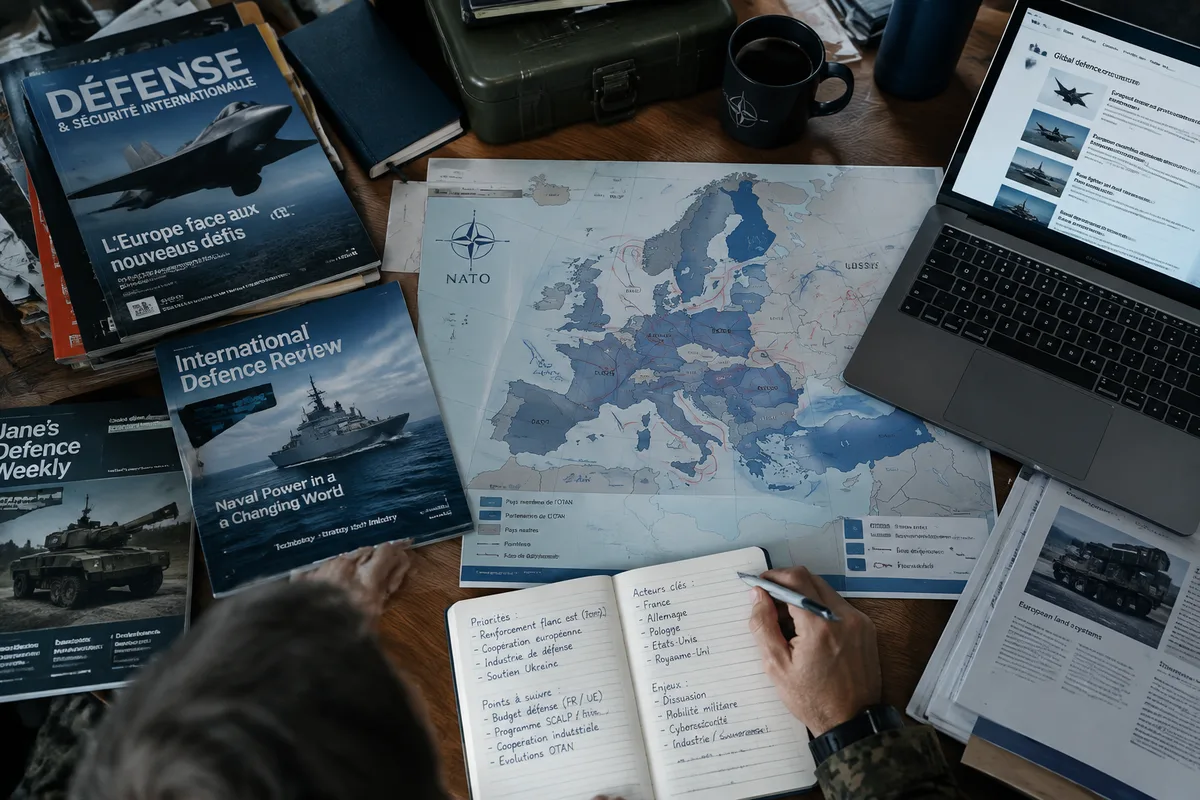
Opex360 wins for France-centered monitoring. Its reporting is particularly useful when the reader needs continuity around French ministries, military services, defense companies, operations, and European cooperation rather than a single breaking headline.
Opex360 also fits a Francophone reader who wants context without translating every institutional term. Its limitation is geographic breadth. A reader tracking Pentagon budget disputes, U.S. congressional decisions, Asian procurement, or worldwide contractor activity needs another publication beside it.
How Does Opex360 Compare With the Leading Military News Sources?
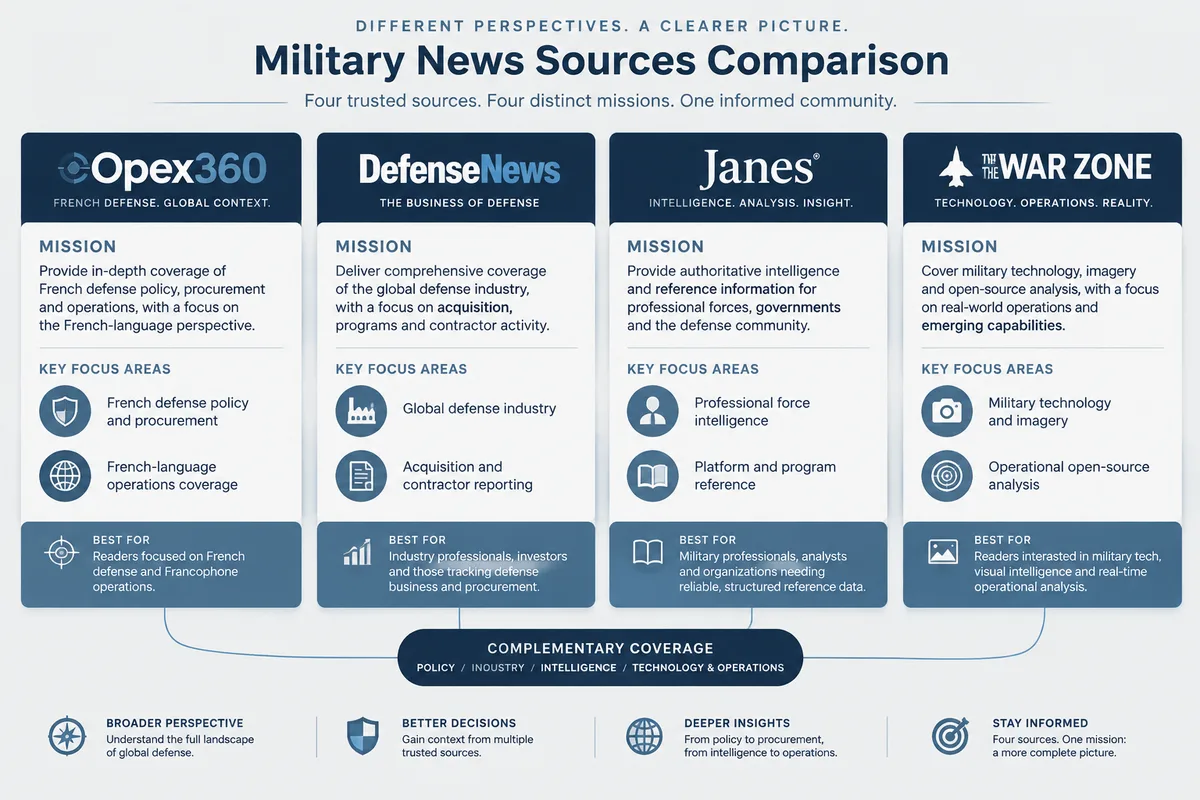
Opex360 is more focused on French defense institutions than the leading English-language outlets, while Defense News reaches further into global procurement and defense business. The War Zone offers deeper technical and visual coverage, and official military pages provide primary announcements rather than independent editorial judgment. The right choice follows geography, language, audience, speed, access, and analytical depth.
| Source | Geographic focus | Editorial strength | Primary audience | Access note |
|---|---|---|---|---|
| Opex360 | France and Francophone Europe | French defense policy, forces, procurement, operations | French-speaking defense readers | Current access conditions should be checked on the publisher’s site |
| Defense News | Global | Defense markets, contractors, acquisition, modernization | Industry and senior defense readers | Current access conditions should be checked on the publisher’s site |
| Defense One | United States and international security | Policy, technology, threats, business, strategic debate | Policy and industry audiences | Editorial and sponsor content appear on the site |
| The War Zone | Global, with strong U.S. coverage | Aircraft, naval systems, weapons, imagery, operations | Technology and open-source analysis readers | Newsletter and video formats are available |
| Janes | Global | Reference intelligence on forces, platforms, and programs | Professional and institutional users | Access and product scope depend on the service selected |
| Department of War News | United States | Official stories, features, press products, and events | Readers seeking primary announcements | The page identifies itself as a simulated response |
Or access changes the practical comparison. A free daily outlet is useful for monitoring, while a restricted professional product may be justified when the reader needs recurring research, searchable reference material, or structured program data. The available evidence does not support a universal subscription ranking.
For a closer look at the national and international ecosystem, this military news sources comparison provides useful context around Opex360, Zone Militaire, Defense News, and related publications.
- Geography: choose the outlet closest to the country, alliance, or conflict being followed.
- Editorial purpose: separate reporting, institutional announcements, technical analysis, and reference intelligence.
- Publication speed: check whether the outlet prioritizes breaking updates, newsletters, long analysis, or database-style research.
- Access: confirm whether the article, archive, application, or professional database is actually available to you.
The Main Alternatives to Opex360
The main alternatives answer different military questions rather than competing on one common scale. Defense News and Breaking Defense are stronger for U.S. policy and procurement; Janes and Defense One add professional or strategic context; The War Zone and Army Recognition deliver more equipment, systems, and open-source detail. The choice should follow the reader’s watchlist.
Defense News and Breaking Defense for U.S. policy and procurement
Defense News is the stronger choice for global defense markets, acquisition programs, contractors, international sales, and military modernization. Breaking Defense is particularly useful for Washington policy debates, budgets, emerging programs, strategic choices, and senior defense interviews. Both fit readers whose watchlist centers on the Pentagon, Capitol Hill, U.S. primes, or transatlantic industrial policy.
Neither replaces Opex360 for detailed French institutional monitoring. They widen the route instead. Check the fallback. If a U.S. procurement claim affects France or Europe, compare the industry report with a French or European source before treating the interpretation as complete.
Janes and Defense One for professional context and strategic analysis
Janes is designed for structured professional intelligence on forces, platforms, conflicts, and defense programs, whereas Defense One explains U.S. national security, defense technology, civil-military policy, and strategic competition in a more accessible editorial format. Janes suits recurring research requirements; Defense One suits readers who need policy meaning and strategic context.
The War Zone and Army Recognition for systems and equipment
The War Zone is particularly valuable for aircraft, naval systems, weapons, satellite imagery, visual evidence, and open-source interpretation of current operations. Army Recognition concentrates on equipment announcements, defense exhibitions, product specifications, land systems, and international industry releases. These sources complement Opex360 when the missing detail concerns hardware, imagery, or battlefield mechanics.
Readers following advanced systems can also consult this guide to advanced U.S. military technology, provided they separate technical description from confirmed operational capability.
Which Source Is Best for Your Military News Needs?
Opex360 is the clear choice here.
A French student, journalist, or informed reader tracking the Ministry of the Armed Forces should begin with Opex360. A defense-industry professional monitoring multinational contracts should begin with Defense News. A reader studying aircraft imagery, naval systems, or weapons employment should begin with The War Zone.
Yet one outlet can fail at the border between reporting and proof. A breaking article may identify a claim without establishing the imagery, contract document, or official statement behind it. Check the fallback. Move to the primary announcement, then return to independent reporting for context.
How Can You Build a Reliable Military News Watch Without One Outlet?
A reliable military news watch combines a national source, an international industry source, and a specialist analytical or technical source. For France, Opex360 plus Defense News and The War Zone covers policy, procurement, and operational technology. For professional research, Opex360 plus Janes offers complementary national reporting and structured specialist reference material.
Start with the geography. A source that is excellent on French deployments may be late or silent on a U.S. congressional decision. Next, define the information type: breaking news, procurement, technology, tactics, or institutional policy.
Then verify the claim’s origin. An official release can confirm that an announcement occurred, while an independent report can challenge omissions, explain incentives, or identify what remains unknown. A satellite image may show a platform, yet it does not automatically establish its mission, readiness, or ownership.
Finally, record the date and the exact wording. Military news changes quickly, and old headlines can resurface after a new event changes their meaning. The reader should preserve the distinction between confirmed movement, reported intention, and analytical inference.
For equipment-focused monitoring, this resource on latest military equipment news can complement a broader policy watch.
Free outlets are sufficient for daily monitoring. Serious research requires source comparison, document retrieval, and a clear record of what has actually been confirmed.
Common Mistakes When Choosing Military News Sources
The most damaging mistakes come from treating every military publication as interchangeable. Readers often confuse official communication with independent reporting, technical analysis with confirmed fact, and a fast headline with a complete account. Avoiding those errors matters because the same event can look different across a ministry page, an industry publication, and an open-source investigation.
- Using one outlet for every region: a France-focused source will not provide complete Pentagon, Asian, or worldwide contractor coverage. Match the source to the geography.
- Treating an official release as independent reporting: primary announcements establish what an institution says, not whether every claim has been independently tested.
- Confusing equipment visibility with capability: a photograph or specification can identify a system without proving readiness, mission success, or operational effect.
- Ignoring access limits: a headline may be visible while the full article, archive, application, or professional reference layer is restricted.
- Repeating an unverified breaking claim: wait for corroboration, identify the original source, and separate confirmed facts from interpretation.
One belief deserves a direct correction: “The fastest military news site is automatically the most reliable.” Speed helps monitoring. It does not replace evidence, attribution, or a second source.
Yet the opposite mistake is also common. A slow analytical publication may explain a development better than a stream of short alerts, especially when procurement language, military doctrine, or satellite imagery requires context.
Frequently Asked Questions
Is Opex360 available in English?
Opex360 primarily serves French-language readers. Its main value is detailed coverage of French defense policy, armed forces, procurement, and operations, so English-language readers may need translation tools or complementary international outlets.
What is the best free source for military technology news?
The War Zone is a strong free starting point for military technology, systems, imagery, and operational open-source analysis. Its reporting should still be separated from official confirmation, especially when a claim concerns capability, readiness, or battlefield effect.