
Before you dial, treat the word latest as a status question. The latest military equipment news covers new weapons, drones, aircraft, ships, missiles, electronic warfare systems, space capabilities, procurement decisions, tests, contracts, and battlefield developments. A useful update identifies the equipment, dates the event, separates confirmed programs from proposals, and explains what evidence supports the claim.
A headline can describe a prototype, a contract, a delivery, or an operational deployment within the same news cycle. Those events do not carry the same military meaning. The reliable reader follows the equipment from requirement to fielding, checks the operator and variant, then asks where the claim fails under closer scrutiny.
| 🧭 | Primary question: What changed, and at which programme stage? |
| 🛰️ | Coverage: Air, land, naval, missile, space, cyber, and electronic warfare systems. |
| 📅 | Freshness: Record publication date and the latest confirmed milestone separately. |
| ⚙️ | Evidence: Prefer contracts, budgets, test records, official releases, and traceable imagery. |
| 🏭 | Production: Distinguish planned quantities from completed deliveries and available units. |
| 🛡️ | Operational meaning: Check training, sustainment, integration, and real mission use. |
What counts as latest military equipment news?
Latest military equipment news becomes useful when it identifies a dated change in a defence system’s status, rather than repeating a launch headline. An announcement signals visibility, a test supplies evidence, a contract creates an acquisition obligation, a delivery creates physical availability, and operational fielding shows that a unit can use the system.
Publication date and programme date answer different questions. A report published today may describe a test completed months ago, while an older article may still document the latest confirmed delivery. Record both dates before calling an item current.
Use precise status labels:
- Announced: an authority or company has presented an intention, concept, partnership, or requirement.
- Demonstrated: a mock-up, exhibition model, laboratory article, or technology demonstrator has been shown.
- Tested: the system has undergone a recorded ground, flight, firing, sea, network, or environmental trial.
- Contracted: a procurement award or signed agreement establishes planned acquisition.
- Delivered: equipment has physically reached the customer or receiving force.
- Deployed: an identified unit or force has used or stationed the system for an operational mission.
- Disputed: the claim exists, but the equipment identity, event, operator, or evidence remains unresolved.
Yet one system may hold several labels at once because a new variant can be contracted while the original version is already deployed. An export order, mid-life upgrade, renamed programme, and entirely new design must therefore appear as separate entries in a tracker.
Which defence systems deserve a serious watchlist?
A serious watchlist follows systems that can change strike range, survivability, sensing, mobility, logistics, command networks, or force readiness. It should cover more than fighter aircraft: missiles, interceptors, drones, autonomous vehicles, radars, satellites, jammers, transport platforms, and maintenance infrastructure can alter a force’s practical capability.
Start with the customer and mission. Then add the manufacturer, variant, production position, expected entry date, and related programme family. The same platform means something different when it is a prototype, an export delivery, or an assigned operational asset.
Air, land and naval platforms
Combat aircraft, helicopters, armoured vehicles, warships, submarines, support vessels, and their mission variants deserve separate records because their readiness depends on different evidence and support systems.
For an aircraft, record the first flight, test campaign, production lot, training pipeline, and receiving squadron. For an armoured vehicle, identify the configuration, protection package, weapon station, communications fit, and unit allocation. For a ship, distinguish keel laying, launch, sea trials, acceptance, and commissioning.
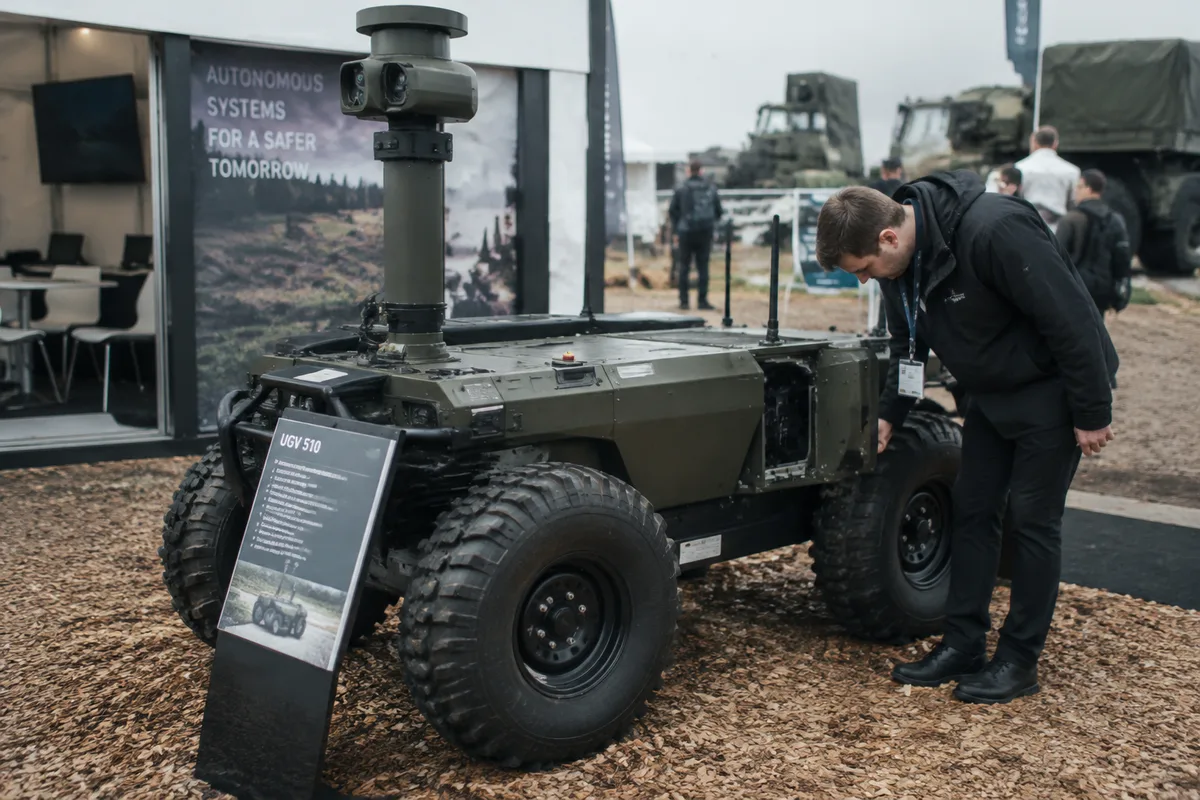
And do not treat a display model as fleet modernisation. A public exhibition can establish programme visibility while revealing nothing certain about serial production, delivery timing, or crew training.
Readers comparing air systems can use this advanced United States military technology overview for broader technical context, provided they keep capability claims separate from fielding evidence.
Missiles, air defence and uncrewed systems
Missile families, interceptors, launchers, loitering munitions, drones, counter-drone systems, and autonomous ground or maritime vehicles need a capability record that connects performance claims with launch method, sensors, integration, and production scale.
- Record stated range and payload only when the source defines the test condition.
- Separate laboratory performance from a complete weapon system used by an operator.
- Identify whether guidance, datalinks, launchers, or command software are already available.
- Track whether real-world use has exposed maintenance, supply, or mission-fit problems.
A hypersonic label describes a speed regime around Mach 5 or above; it does not establish manoeuvrability, accuracy, survivability, or operational deployment. Similarly, a laser demonstration establishes directed-energy activity, not an integrated air-defence battery ready for routine use.
Electronic warfare, space and command networks
Radars, jammers, passive sensors, satellites, tactical data links, command nodes, and cyber-enabled defence capabilities often matter through the forces they connect rather than through their physical size.
Track whether the update concerns a standalone item, a software release, a sensor upgrade, or one layer in a networked architecture. A new radar may require a compatible command system, trained operators, protected communications, and an available power or vehicle platform.
Or a headline about artificial intelligence may describe a decision-support trial rather than autonomous authority to select and engage targets. Where does it fail? The answer usually sits in the integration record, not the promotional description.
How does a programme move from concept to operational use?
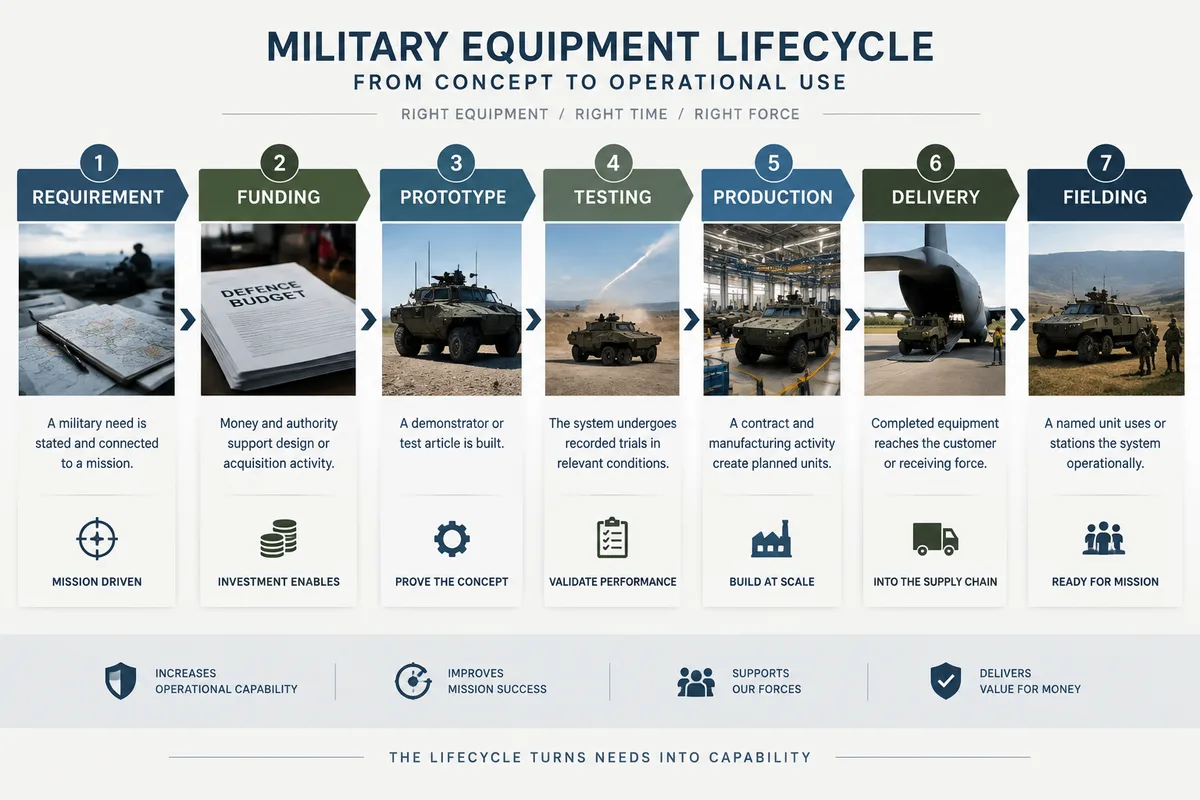
A defence programme moves through identifiable stages: requirement, funding, design, prototype, testing, contract, production, delivery, initial operational capability, and wider deployment. The sequence can overlap, pause, or reverse, so every update should state the completed milestone and keep forecast dates visibly separate.
Funding establishes permission to develop or buy. A prototype demonstrates an article. A test exposes evidence under defined conditions. A production contract creates a plan. Delivery creates physical possession. Initial operational capability means a force has reached a defined usable threshold, while full operational capability represents a broader readiness target.
Funding, prototypes and test evidence
Funding, a displayed mock-up, and a flying or firing prototype represent different levels of maturity. A useful record connects the requirement to a budget line, identifies the test article, and states whether the trial succeeded, was delayed, or changed the design.
Use a technology-readiness scale only as a supporting description. TRL 1 begins with observed principles, while TRL 9 represents a real system demonstrated in an operational environment; the scale does not replace procurement evidence.
Test reports, official imagery, range activity, procurement documents, and manufacturer disclosures become stronger when they align on the same variant and date. A cancelled test matters too. It changes the likely fielding path.
However, an exhibition rendering cannot establish production maturity. It shows that a programme is being presented publicly, not that the equipment has passed certification or reached a unit.
Production, deliveries and unit fielding
A production contract establishes planned acquisition, while completed deliveries establish physical availability. Initial operational capability, deployment to a named unit, and full operational capability remain separate readiness thresholds even when a press release places them close together.
Check the fallback. When delivery figures are unclear, compare contract modifications, acceptance notices, budget documents, training activity, and receiving-unit releases.
Delivery totals gain meaning only when matched with munitions, maintenance capacity, spare parts, training hours, secure communications, and integration into the receiving force. A vehicle in a warehouse is not equivalent to a vehicle in a trained formation.
-
Capture the event
Write the publication date, event date, equipment designation, operator, and location.
-
Classify the milestone
Choose announcement, test, contract, production, delivery, initial capability, deployment, or disputed claim.
-
Check the evidence
Compare official records, imagery, contract language, and independent reporting before upgrading the status.
How can you assess whether a new equipment claim is credible?
Assess a claim by matching the exact designation, variant, operator, supplier, quantity, date, and location before combining reports. Rank contract awards, budget documents, armed-force releases, and test records above promotional language, then label the result as completed, intended, estimated, alleged, or observed.
Official evidence carries the most weight when it describes a completed event and identifies the relevant system. A manufacturer statement is valuable for production or design information, yet it remains a company claim until a customer, contract, test record, or independent evidence supports the specific point.
Specialist reporting can connect fragmented evidence, especially when procurement language is difficult to read. Battlefield imagery may show presence or use, but identity, date, location, and operator still require verification.
A repeated headline is still one claim if every article copies the same announcement. Count independent evidence trails, not the number of websites carrying identical wording.
Terms such as “combat-proven” require particular care. They may describe a platform, a weapon, a sensor, or a mission package, and each has a different evidentiary burden.
For international systems, check export approval, end-user restrictions, training arrangements, and local integration. A customer may have ordered equipment without receiving permission to employ every advertised capability.
Recent defence reporting also shows why sustainment belongs in the same assessment. The Senate of France describes military equipment maintenance spending through four categories, including scheduled maintenance, personnel-related expenditure, state service operations, and initial support. Its material links support credits to programmes 146, 178, and 212, with programme 178 covering in-service support and programme 212 covering personnel costs.
That distinction changes the reading of a large acquisition announcement. The purchase price may describe the initial equipment while training, spares, maintenance contracts, infrastructure, and upgrades determine whether the force can keep it available. A 2 October 2024 Senate review also recommended a full assessment of outsourced maintenance contracts, including their financial effects. Source: Senate of France.
For a wider daily briefing, an OpenX360 defence news source can help locate reports, while the underlying contract or official release should decide the status label.
What workflow keeps latest military equipment news current?
A repeatable workflow begins with a watchlist of system names, alternate spellings, programme titles, manufacturers, armed forces, procurement agencies, and unit designations. Alerts then capture contracts, trials, first flights, launches, deliveries, export approvals, upgrades, production expansion, and deployment announcements.
Daily monitoring catches time-sensitive releases and operational claims. Weekly review connects those items to budgets, industrial capacity, delivery schedules, training, and force-structure changes.
Use a dated change log:
- Identity: system, designation, variant, country, service, and mission.
- Event: what happened, where, when, and who reported it.
- Status: announced, tested, contracted, produced, delivered, deployed, proposed, or disputed.
- Evidence: original release, contract, budget document, imagery, test record, or specialist report.
- Confidence: confirmed event, attributed claim, estimate, allegation, or unresolved observation.
- Change: the precise difference from the previous confirmed milestone.
Remove cancelled, merged, or dormant programmes from priority monitoring while retaining their historical record. Do not delete them entirely, because a later revival can make the earlier cancellation relevant.
Yet a single confirmed milestone can outweigh a large volume of repeated commentary. A delivery notice tied to a receiving unit usually matters more than several speculative articles about a future design.
For questions about equipment already operating, compare the tracker with this guide to newest military technology in operation, then return to the original evidence trail.
What should a military equipment news tracker record?
A useful tracker records identity, mission, operator, manufacturer, source, publication date, event date, lifecycle stage, quantity, delivery schedule, integration dependencies, and confidence level. It should preserve the original wording and link for major claims so later corrections can be traced to the underlying record.
Do not build a database that stores headlines without change. The meaningful question is whether the programme advanced beyond its previous confirmed milestone.
| Field | What to record | Why it matters |
|---|---|---|
| System identity | Name, designation, variant, and programme family | Prevents similarly named systems from being merged. |
| Country and operator | Customer, service branch, receiving unit, and export destination | Shows who can use the equipment and where. |
| Mission | Strike, air defence, sensing, mobility, logistics, command, or support role | Connects equipment to force capability. |
| Programme stage | Proposal, prototype, test, contract, production, delivery, or deployment | Stops an announcement becoming a false readiness claim. |
| Quantities and finance | Ordered amount, delivered amount, contract value, and funding category | Separates planned scale from available equipment. |
| Evidence trail | Source, publication date, event date, wording, and confidence | Allows corrections and later verification. |
| Operational dependencies | Training, munitions, maintenance, software, infrastructure, and interoperability | Measures practical usefulness beyond specifications. |
Industrial constraints belong in the same record. Production can slow when components, skilled labour, supplier capacity, certification, or transport infrastructure fall short of the planned schedule.
Interoperability also changes the result. A platform may require compatible data links, weapons, refuelling, maintenance tooling, secure networks, or doctrine before it contributes to a wider force.
And specifications should remain separate from observed performance. Manufacturer figures describe intended or tested capability under stated conditions; operational evidence may reveal weather limits, electronic interference, maintenance burdens, training gaps, or supply pressures.
Where figures are unavailable, leave the field marked “not confirmed” rather than filling it with an estimate. A blank evidence field is safer than a precise number detached from a source.
Frequently Asked Questions
What is the newest U.S. military equipment?
There is no single answer because “newest” may refer to a recently announced design, a system entering testing, a newly contracted platform, or equipment already delivered to U.S. forces. The newest U.S. item by public announcement may therefore be less mature than a system that has recently reached operational use.
How do export controls affect the delivery of military equipment?
Export controls can delay or limit transfers by requiring approval for the equipment, its components, software, weapons, or re-export to another country. They may also restrict the end user, training arrangements, or the capabilities that the recipient is allowed to employ.
Why can a military programme be cancelled after successful testing?
A successful test proves performance under defined conditions but does not guarantee funding, affordability, industrial capacity, interoperability, or continued military need. A programme may therefore be cancelled when priorities change, costs rise, or another system offers a more practical capability.
What is the difference between a military platform and its variant?
A platform is the basic aircraft, vehicle, ship, missile, or drone design, while a variant is a configuration adapted with different sensors, weapons, software, protection, or mission equipment. Two variants of the same platform can have different operators, performance, logistics needs, and operational roles.