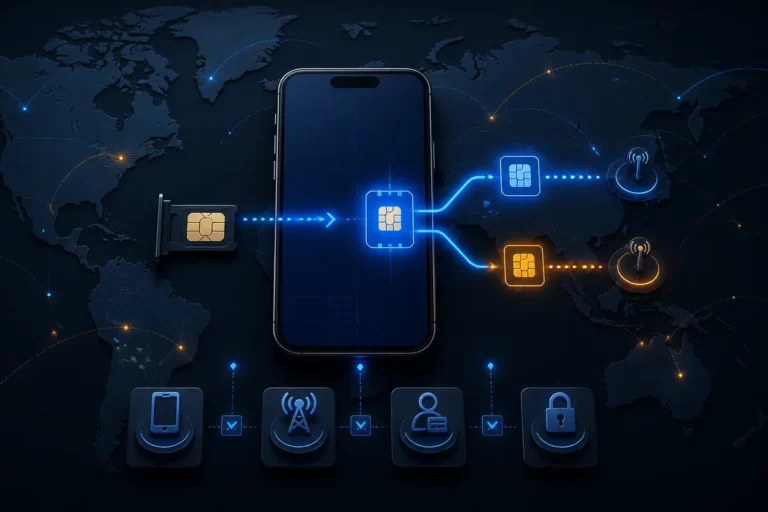
1 practical route is to use a mobile carrier, virtual phone provider, or secondary-number service that currently offers New York City numbers. Select a new number, search specifically for the 929 area code, choose a plan, and activate it after checking calling, texting, voicemail, emergency-service, and portability conditions.
A New York address is generally not required by the providers described for this type of purchase, although identity checks, billing details, service-address rules, and number inventory vary. The safest process is simple: request a new 929 number, verify all ten digits before payment, then test calls, SMS, voicemail, and account recovery.
| 📍 | Coverage: 929 serves the Bronx, Brooklyn, Queens, and Staten Island in New York City. |
| 📞 | Acquisition: Search for a new number through a mobile, VoIP, or secondary-number provider. |
| 🏠 | Address: A New York address is generally not required, but provider verification rules still apply. |
| 🔢 | Dialing: Use the complete ten-digit number for domestic calls; use +1 929 internationally. |
| 💬 | Features: SMS, voicemail, forwarding, verification texts, and emergency calling depend on the service. |
| ⚠️ | Availability: A provider may have limited 929 inventory, and prices or plan conditions can change. |
What is the quickest way to get a 929 number?
You can get a 929 number by choosing a provider with current New York City inventory, selecting a new local number, choosing the required plan, and completing activation. Or, request a new number rather than porting an existing one when the 929 prefix is essential, because porting normally preserves the number you already have.
- Choose a mobile carrier, virtual business phone provider, or secondary-number service.
- Open the provider’s number-selection screen and enter 929 as the preferred area code.
- Review the full ten-digit number, plan terms, taxes, fees, and included features.
- Complete verification, activate the line, and test calls, messages, and voicemail.
Start with a new-number search. That is the direct route.
If the first search returns another New York City area code, do not assume that changing your billing address will create a 929 number; the provider must have an available number in that inventory. Ask support to perform a manual search, then try another provider if the answer remains negative.
Which type of 929 number fits your use?
A mobile-carrier number suits ordinary personal use, while a virtual phone number fits business calling, remote work, forwarding, or multiple users; a secondary-number service suits privacy and separate communications. Or, choose the service by its required features rather than by the area code alone, because two 929 numbers may have different SMS, emergency-calling, and porting capabilities.
| Option | Best use | Check before activation |
|---|---|---|
| Mobile carrier | Personal calls and standard mobile use | Device compatibility, monthly plan, SMS, voicemail, and number-change rules |
| Virtual phone provider | Business lines, remote teams, and call routing | Users, forwarding, recordings, desktop access, texting, and emergency calling |
| Secondary-number service | Privacy, classified listings, or a separate personal line | Verification-text support, renewal terms, calling limits, and number retention |
Choose a carrier for a primary mobile line. Choose VoIP for routing.
Virtual services may provide mobile applications, desktop calling, voicemail transcription, caller ID, or team access, but those features belong to the plan rather than to the 929 area code. A secondary number can separate personal and public communications without requiring another physical SIM, yet some websites reject virtual or recycled numbers for account verification.
Or, do not pay for business features when you only need a private second line. A mobile line is the better fit for regular device use, while a business service is the stronger choice when several people must answer the same number.
How do you activate a 929 number?
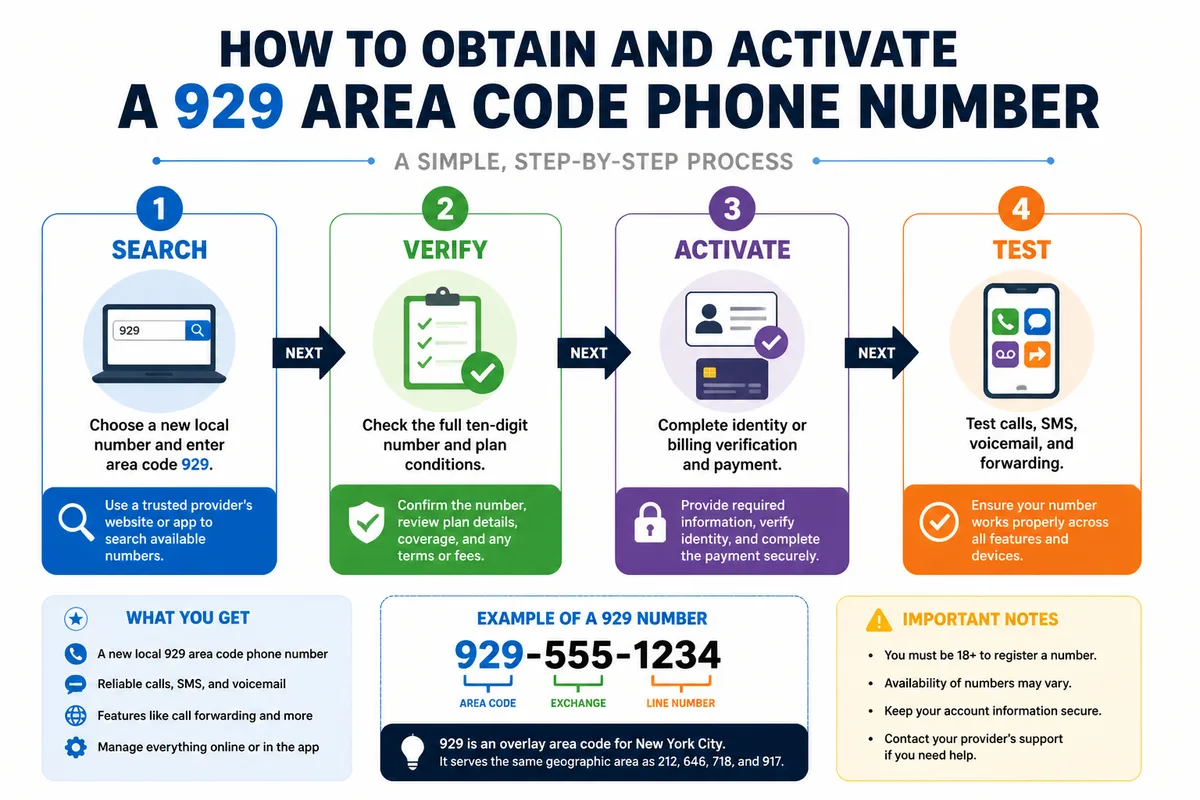
Activation usually follows four actions: create an account, search the provider’s available local numbers, select a 929 number, and complete payment or verification. Or, treat the displayed number as provisional until the final confirmation page shows both the 929 area code and the complete ten-digit number you intend to keep.
Step 1: Open a new-number search
Select “new number” or the equivalent option in the provider dashboard. Do not choose “port” when you want a newly issued 929 number.
Enter 929 when the search tool accepts a preferred area code. Some services show only available combinations, so search again if the first list contains no suitable number.
Step 2: Verify the number and plan
Read every digit before continuing. Check the monthly charge, setup fee, regulatory fees, included minutes, SMS eligibility, voicemail, forwarding, and renewal conditions.
Or, save a screenshot or confirmation email before activation. That record helps if the selected number changes during checkout or if support later needs to locate the order.
Step 3: Complete verification and activate
Provide the requested identity, billing, or service-address information. A VoIP provider may request an emergency address even when it does not require a New York address for the phone number itself.
Activation should leave the number visible in your account. Test it immediately.
Step 4: Test every required function
Place an outgoing call, receive an incoming call, send an SMS, receive a reply, and leave a voicemail. If the number will support a business, also test forwarding, caller ID, shared access, and any verification messages that matter to your workflow.
Keep the account recovery details secure. Store the transfer PIN if the provider supplies one.
Do you need a New York address?
Usually, a provider can offer a 929 number without requiring the customer to live in New York, according to the provider flows described for local-number services. Or, separate geographic availability from emergency-service registration: a New York address may be unnecessary for selection, while a valid service address can still be required for VoIP emergency calling.
Location checks still vary by product. A mobile carrier may assess identity, billing, or account eligibility; a business VoIP service may request company details; and an emergency-services configuration may require the physical location where calls originate.
No New York address? Ask the provider first.
Do not use a false address to force a local number. It can create billing problems, prevent emergency responders from receiving accurate location information, or breach the provider’s terms.
Or, if the signup page asks for an emergency address, enter the location where the service will actually be used and update it after a move. For a fixed VoIP setup, the address attached to the service matters more than the city suggested by the area code.
Where does area code 929 apply?
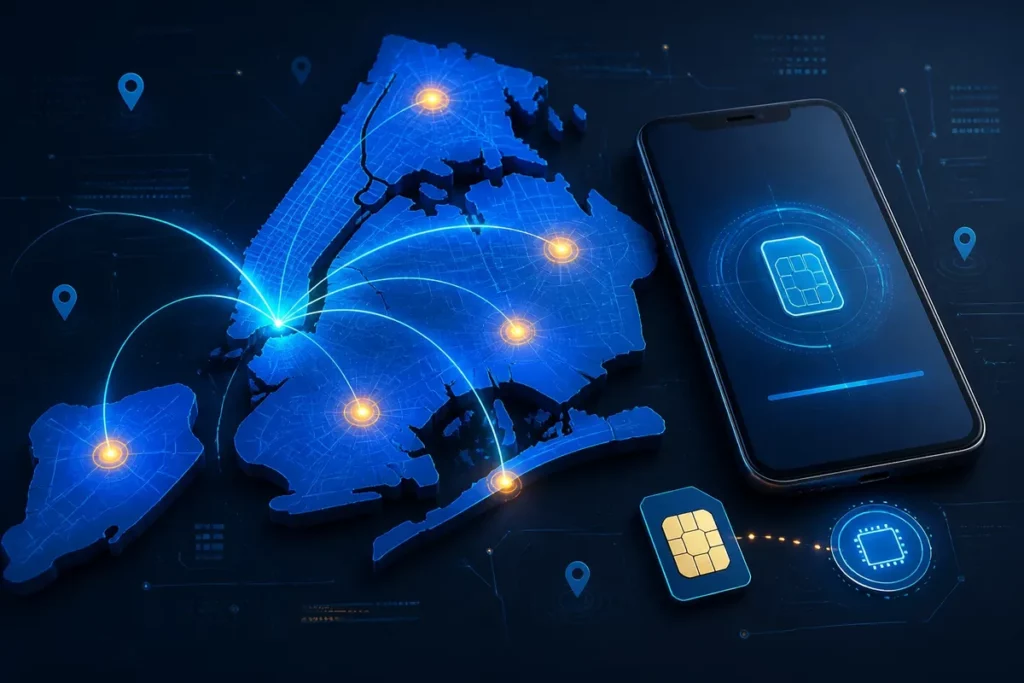
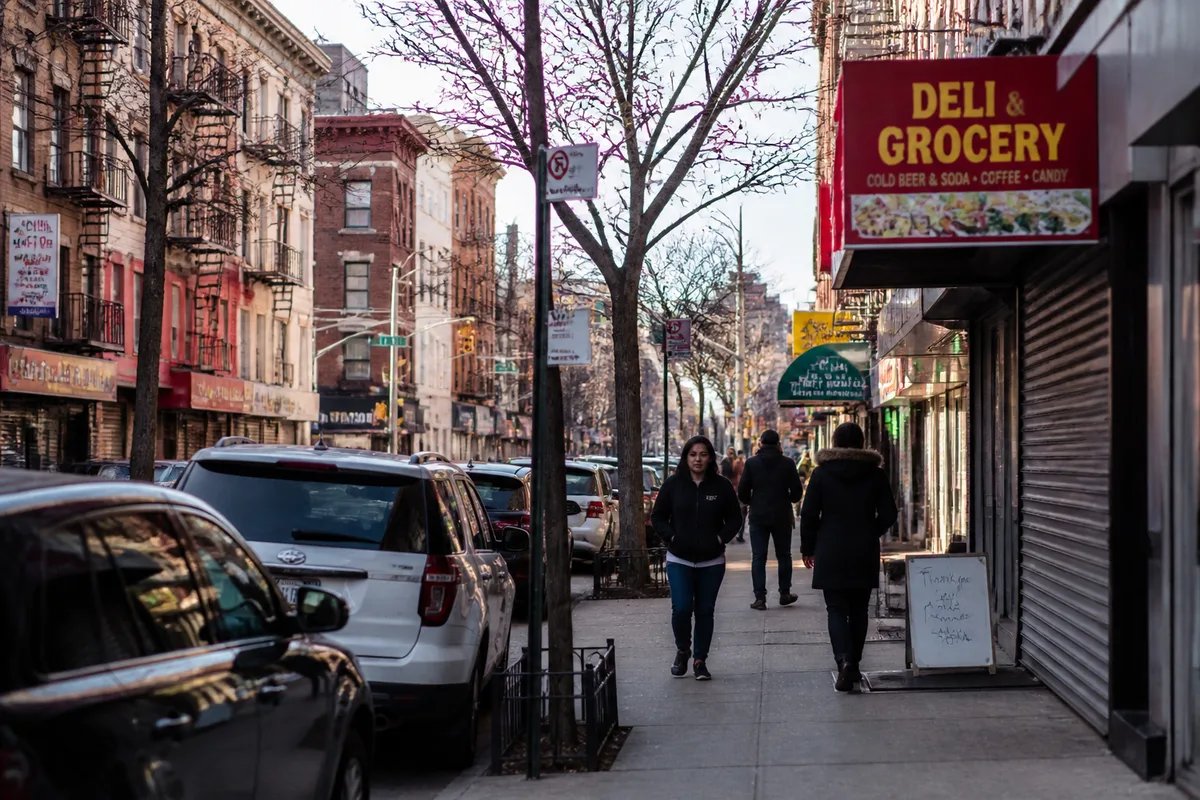
Area code 929 serves four New York City boroughs: the Bronx, Brooklyn, Queens, and Staten Island. Or, remember that the code was introduced in 2011 as an overlay serving the same broad territory as existing New York City codes, including 718 and 347, rather than identifying one precise neighborhood.
The area uses Eastern Time, with seasonal daylight-saving changes applying to New York. Marble Hill creates a geographic detail worth checking because it is legally associated with Manhattan while appearing in descriptions of the broader 929 overlay territory.
For additional historical context, read this explanation of the 929 area code history before treating the prefix as a neighborhood locator.
A 929 number does not prove that its user lives in one of those boroughs. Numbers can be assigned remotely, transferred between providers, or used through internet services.
Or, look at the actual service address and network arrangement when location matters. The prefix describes numbering geography, not a guaranteed physical presence.
How should you call and text a 929 number?
Use the full ten-digit number for ordinary domestic calling in the 929 overlay region, including the area code and seven-digit local number. Or, use the international format +1 929 followed by the remaining seven digits when calling from outside the United States or Canada.
Seven-digit dialing is a poor default for 929 calls. Full ten-digit dialing avoids confusion in an overlay area and matches the safer current guidance for general use.
- Domestic format: 929-XXX-XXXX.
- International format: +1 929 XXX XXXX.
- Texting: Confirm that the plan supports inbound and outbound SMS.
- Verification: Ask whether short codes, two-factor messages, and automated texts are supported.
A local-looking caller ID also does not prove that the caller is in New York. Caller ID can be spoofed, so investigate unexpected requests for money, passwords, or access codes through an independent channel.
Or, use the service’s published SMS and caller-ID rules rather than assuming every 929 number works like a standard mobile line. Calling and texting capability follows the provider and plan.
What should you do if no 929 number is available?
If no 929 number appears, check another provider, ask support to search its inventory, and return later because numbers are released, disconnected, reassigned, or temporarily unavailable. Or, reject another area code when the 929 prefix is essential; accepting a different number and expecting a later area-code change usually creates unnecessary porting work.
- Search several number patterns instead of one memorable combination.
- Check a mobile carrier and a virtual-number provider separately.
- Ask whether the number is newly issued, recycled, or restricted for SMS verification.
- Confirm the cancellation, refund, and number-retention rules before payment.
Do not confuse a provider’s general claim that it offers New York numbers with live 929 inventory. The exact prefix must appear beside the full number at selection or checkout.
Or, compare total cost rather than the advertised monthly rate: include activation, taxes, regulatory charges, usage fees, premium-number charges, credits, and extra users. Prices are provider-specific and can change, so verify the current offer directly before purchase.
Can you port or keep a 929 number?
You may be able to port an existing 929 number to another eligible provider, but the receiving service must support that number’s location, carrier type, and account status. Or, request a portability check before cancelling the old service, because cancellation can remove access to the number before the transfer is complete.
Porting an existing number normally preserves its area code. It does not turn a non-929 number into a 929 number.
Keep the old account active during the transfer process. Gather the account number, transfer PIN, billing name, service address, and any authorization details requested by both providers.
Number retention also depends on account security. Use a strong password, multi-factor authentication where offered, recovery codes, and a separate email address that you control.
Or, contact the provider immediately after a suspicious SIM change, password reset, or porting request. A 929 number has the same account-takeover risks as other phone numbers.
What emergency-calling limits apply to VoIP 929 numbers?
VoIP users must check how emergency calling is configured before relying on a 929 service. Federal rules for interconnected VoIP include automatic transmission of an emergency address for fixed services from January 6, 2021, and additional location requirements for non-fixed services from January 6, 2022.
The address must match the place where the service is used. A remote worker who moves between locations should ask how the provider updates emergency information.
Kari’s Law also requires direct 911 dialing and on-site notification for covered multiline telephone systems. The exact obligations depend on the system and premises.
Or, never assume that an app-based 929 number provides the same emergency behavior as a conventional mobile line. Read the provider’s E911 terms and complete its address process before treating the service as an emergency connection.
929 area code questions
Is 929 a country code?
No. 929 is a United States area code within the North American Numbering Plan. International callers use country code +1 before the 929 area code.
Is 929 a mobile number or a landline?
The area code alone cannot identify the line type. A 929 number may be assigned to a mobile carrier, landline service, VoIP provider, or secondary-number platform.
Is a 929 call always from New York?
No. The number is associated with a New York City numbering area, but users can live elsewhere, callers can use internet services, and caller ID can be spoofed.
Can you get a free 929 number?
A provider may advertise a trial, credit, or limited plan, but a permanently free 929 number with unrestricted calling and texting should not be assumed. Check renewal charges, taxes, verification limits, and number-retention rules before signing up.
What is the safest first step?
Search a provider’s live inventory for a new 929 number, then verify the full ten-digit number and its plan conditions before paying. For broader location, time-zone, coverage, and scam-call context, consult this 929 area code coverage guide.
What to remember
- Request a new number when the 929 area code matters.
- Choose mobile, VoIP, or secondary service according to the required features.
- Verify SMS, voicemail, forwarding, emergency calling, and portability separately.
- Use ten-digit domestic dialing and +1 929 internationally.
- Confirm live inventory and the complete cost before activation.
Choose the provider only after its current inventory, total charges, emergency-address rules, and required features are confirmed for your use, if the 929 prefix is essential.