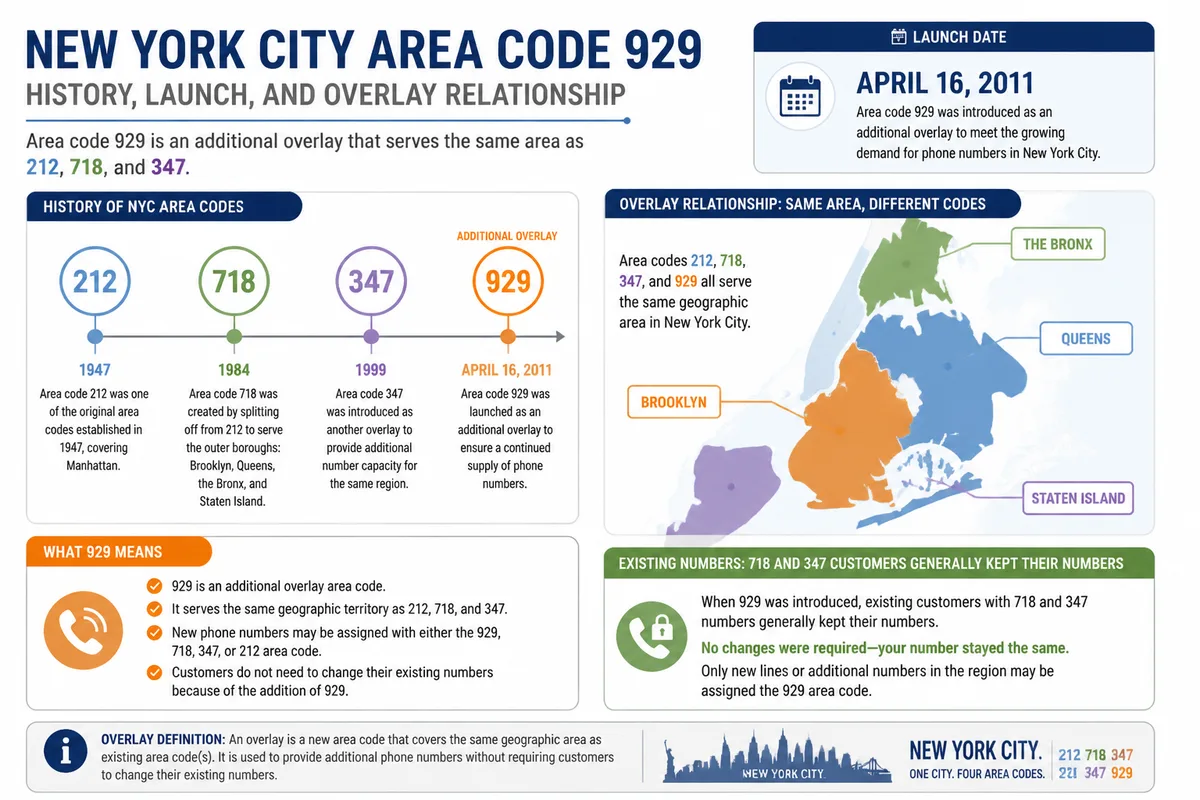
929 entered service on April 16, 2011, in New York City’s outer-borough numbering territory. It was added as an overlay for the existing 718 and 347 region, giving carriers more numbers without forcing established customers to replace their telephone numbers.
The 929 area code history begins with New York’s long shift from a mainly 212-based system to a layered plan serving Brooklyn, Queens, the Bronx, Staten Island, and parts of the wider city numbering structure. A 929 number identifies a numbering assignment, not the caller’s current location.
| 📅 | Launch date: 929 entered service on April 16, 2011. |
| 🗺️ | Historical territory: It serves New York City’s outer-borough numbering region. |
| 🔢 | Overlay role: 929 was placed over the existing 718 and 347 territory. |
| 🏙️ | Main boroughs: Brooklyn, Queens, the Bronx, and Staten Island are included. |
| ☎️ | Existing numbers: Customers with 718 or 347 generally kept their numbers. |
| ⚠️ | Caller identity: An area code alone cannot prove where a caller is now. |
When Did the 929 Area Code Start?
Or, the 929 area code started on April 16, 2011, when it entered service as an overlay in New York City’s outer-borough numbering territory. The date refers to active numbering service, while the planning and approval process occurred beforehand as regulators addressed declining number availability.
That date matters. It separates the 929 launch from later discussions about New York’s evolving overlay system.
Or, the practical change was capacity rather than geography. Existing 718 and 347 subscribers did not receive a new code simply because 929 became available. New assignments could use 929 within the same eligible numbering region, preserving established numbers and reducing the disruption of a geographic split.
The New York Public Service Commission’s role was tied to numbering demand and the need for additional capacity. The exact regulatory order should be checked in the commission’s telecommunications records before publication of a formal historical reference. NANPA records remain the appropriate place to verify numbering-plan status and in-service details.
Why Was 929 Added as an Overlay?
Or, New York added 929 to expand numbering capacity in a region already served by 718 and 347. An overlay places another area code across the same territory instead of cutting that territory into newly assigned geographic zones, allowing new customers to receive numbers without mass renumbering.
The overlay solved a capacity problem without redrawing borough boundaries. Wireless lines, business connections, fax machines, and other connected services increased demand for telephone numbers over time.
Or, a geographic split would have created a different kind of burden. Some customers would have needed new numbers, businesses would have updated stationery and records, and callers would have adjusted stored contact information.
- New numbers could be assigned inside the existing service territory.
- Customers with established 718 or 347 numbers could keep them.
- Businesses avoided a region-wide change to published contact details.
- The numbering plan gained capacity without creating a new borough boundary.
The choice of 929 reflects the overlay method, not a special geographic identity attached to the digits. Available numbering codes are assigned through the North American Numbering Plan process, so the historical record supports the capacity explanation more clearly than any claim about why those particular three digits were selected.
Which Parts of New York Are Covered by 929?
Or, the 929 overlay primarily covers Brooklyn, Queens, the Bronx, and Staten Island within New York City’s outer-borough numbering territory. Marble Hill is often discussed separately because its legal borough classification and telephone numbering context do not fit a simple map-based explanation.
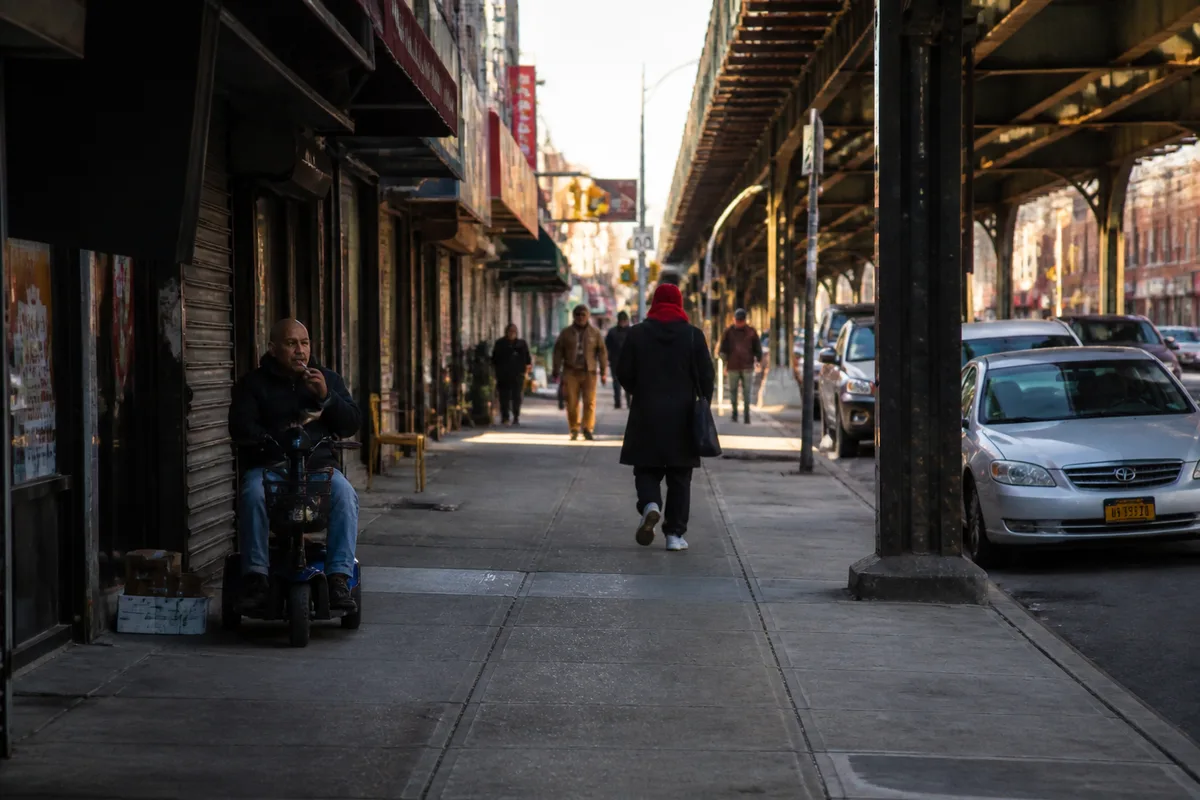
Look at the numbering territory, not the caller’s current position.
Or, the safest geographic description is the shared outer-borough region rather than a 929-only map. The area code does not identify one neighborhood, one borough, or one telephone company.
Marble Hill requires care because references describe it alongside the outer-borough codes even though its municipal classification is more complicated. Treat that detail as a numbering-plan qualification, not proof that every nearby Manhattan number uses 929.
For a practical location explanation, see this overview of 929 area code location, which separates territory, time zone, coverage, and caller-identification issues.
How Did New York’s Area-Code History Lead to 929?
Or, 929 emerged after New York moved from a simpler 212-centered system toward several overlapping area codes. Area code 718 was created in 1984 for Brooklyn, Queens, and Staten Island initially, and later overlays expanded the number pool serving the same broader outer-borough region.
The chronology is easier to follow when the codes are separated by role:
| Code | Historical role | Relationship to 929 |
|---|---|---|
| 212 | Older Manhattan-centered numbering history | Part of the background to New York’s later expansion |
| 718 | Created in 1984 for the outer-borough numbering area initially | 929 later overlaid its relevant territory |
| 347 | Additional overlay for the 718 territory | 929 joined the same numbering structure |
| 917 | Citywide overlay context | Often listed alongside the New York overlay system |
| 929 | Additional overlay launched in 2011 | Expanded capacity without a geographic split |
| 465 | Later-status claim requiring current official verification | Do not treat its 2026 status as established here |
Or, the key sequence is 718 first, 347 next, and 929 after that. The 929 launch therefore represents another layer in an existing numbering plan rather than a sudden replacement of an older code.
Historical references sometimes describe 929 as being added to the 347 region. That wording is shorthand. The more precise explanation is that 929 joined the existing outer-borough overlay territory associated with 718 and 347.
Current overlay claims require a dated check. A later code may appear in commercial or reference material before official numbering records are consistently updated, so verify any 2026 development through NANPA or the relevant New York regulator.
What Changed for Customers When 929 Began?
Or, customers who already held 718 or 347 numbers generally kept them when 929 entered service. The overlay applied mainly to new number assignments, so the launch expanded available numbers without requiring existing households and businesses to replace their contact details.
That distinction is important for businesses. A company could continue publishing its established telephone number while a new customer in the same region received a 929 number.
Or, the numbering change affected dialing habits and equipment configuration more than customer identity. Phone systems, address books, printed directories, alarm equipment, fax systems, and caller-ID databases may need to handle the complete telephone number correctly.
- Check how a private switchboard stores full telephone numbers.
- Review older fax, alarm, and call-forwarding equipment.
- Confirm local dialing rules with the carrier serving the line.
- Update business records only when the assigned number actually changes.
The precise dialing requirement can depend on the applicable numbering rules and the carrier’s implementation. Confirm local-call behavior with the provider rather than assuming that a phone configured for older seven-digit dialing will continue to work unchanged.
Or, a new 929 number does not automatically mean a mobile line. It may be associated with wireless, fixed, business, or internet-based service, depending on the carrier and the assignment.
Readers comparing the neighboring codes can use this guide to compare 929 vs 718 area codes without treating one code as a separate city.
What Does a 929 Number Tell You Today?
Or, a 929 number tells you that the number was assigned within the relevant New York City overlay territory at some point. It does not prove that the caller currently lives in New York, uses a mobile phone, or is physically located in the borough associated with the number.
New York operates in Eastern Time, according to the commonly cited area-code references for this numbering region. That time-zone detail can help when scheduling a legitimate call, yet it still says nothing about the caller’s identity.
A person may keep a number after moving. A provider may route calls through another location. Voice-over-internet services can use local numbers remotely. Caller-ID spoofing can also make a displayed number misleading.
Area code 929 is legitimate; the caller still needs separate verification. Do not treat the code as proof that a message, missed call, payment request, or account warning is genuine.
Or, a text message from 929 should be assessed by its content and the requested action. Avoid sending passwords, payment details, verification codes, or identity documents in response to an unexpected message.
Someone who needs a local number can review how to get a 929 area code number, then check the provider’s terms for portability, service location, and recurring charges.
929 Area Code History FAQ
Or, the central historical answer is straightforward: 929 entered service on April 16, 2011, as an overlay for New York City’s outer-borough numbering territory. The details that require care concern shared coverage, number portability, caller identity, and later changes to the overlay system.
Is 929 a New York City area code?
Yes. Area code 929 is associated with New York City’s outer-borough numbering territory, including Brooklyn, Queens, the Bronx, and Staten Island. Historical references also discuss Marble Hill as a numbering qualification.
Is 929 an overlay or a geographic split?
929 is an overlay. It shares the relevant numbering territory with existing codes rather than assigning a completely separate geographic zone to customers receiving the new code.
Did 929 replace 718 or 347?
No. Customers with established 718 or 347 numbers generally retained them. 929 expanded the pool of numbers available for new assignments.
Does 929 identify a mobile phone?
No. The area code alone cannot establish whether a number is wireless, fixed-line, business, or internet-based. Carrier assignment and number portability determine that information.
Is every call from 929 local or trustworthy?
No. A displayed area code can be retained after relocation or manipulated through caller-ID spoofing. Verify unexpected requests through an independent official contact channel.
Sources to Check for the Historical Record
Or, the strongest verification path combines numbering-plan records with state regulatory material. Use historical summaries for context, then confirm the launch date, territory, and current overlay status against an official record before relying on a later development.
- North American Numbering Plan Administrator: check numbering-plan documents, area-code assignments, and in-service information.
- New York Public Service Commission: check telecommunications orders and proceedings concerning New York area-code overlays.
- Carrier documentation: confirm dialing behavior, portability, equipment compatibility, and current service conditions.
- Caller’s organization: use an independently located phone number when checking an unexpected call or text.
Or, keep the historical date separate from current inventory claims. The April 16, 2011 launch is the stable answer to the 929 area code history question, while any later overlay status should be verified against the official numbering plan available on the publication date.
Key Points
- 929 entered service on April 16, 2011.
- It was introduced as an overlay, not a geographic split.
- Its main historical territory includes Brooklyn, Queens, the Bronx, and Staten Island.
- Existing 718 and 347 customers generally kept their numbers.
- A 929 caller may be outside New York, so verify unexpected contact independently.
The historical answer is fixed, while present-day coverage should be checked against the official numbering plan if 2026 updates change the overlay system.