
Before you dial into a military news feed, decide what kind of evidence you need. Military news sources fall into three broad groups: official defense news, independent military journalism, and specialist defense technology or policy analysis. A useful source list separates reporting, official announcements, analysis, editorial opinion, and sponsored content instead of treating every headline as equivalent.
The same event can look different across France, the United States, NATO headquarters, a defense contractor, and a military ministry. Language, access, geography, publication date, and commercial relationships shape the result. A contract announcement needs one reading method; a battlefield claim needs another. The cheap shortcut breaks when the source’s role changes.
| 📰 | Independent reporting: Useful for events, interviews, context, and competing accounts. |
| 🏛️ | Official defense news: Strong for formal announcements, named decisions, and institutional positions. |
| ⚙️ | Industry coverage: Tracks procurement, contractors, budgets, exports, and programme milestones. |
| 🛰️ | Technology specialists: Explain aircraft, naval systems, drones, space, cyber, and electronic warfare. |
| 🧭 | Policy analysis: Connects military developments with strategy, budgets, alliances, and geopolitics. |
| 🔎 | Best verification habit: Pair a specialist report with a primary document and a second perspective. |
What military news sources cover, and why their roles differ
Military news sources cover operations, force posture, procurement, defense budgets, weapons programmes, strategy, technology, and security policy, yet no single outlet handles all of those areas with equal depth. The source’s language, geographic remit, audience, and institutional access decide which facts appear first and which consequences receive attention.
Specialist journalism reports events and adds context. Trade publications follow contracts, companies, markets, and production schedules. Analytical outlets interpret consequences for strategy or national security. Official channels publish institutional records, press releases, speeches, images, and formal statements.
A headline tells you what happened; the source type tells you how to read it. A ministry announcement may establish that a decision was made, while an independent reporter may reveal disagreement around it. A defense company can confirm its own statement and still present the programme in the most favorable commercial light.
Yet ownership and financing matter. A publication may belong to a larger media group, rely on subscriptions, accept advertising, publish sponsored material, or operate near a professional association without being controlled by it. Those conditions do not automatically invalidate reporting. They tell you where to inspect disclosure, sourcing, and editorial separation.
- Breaking event: look for a dated report, named source, location, and clear distinction between confirmed facts and claims.
- Procurement story: separate requirement, budget approval, contract award, production, delivery, and operational use.
- Technology story: identify the platform, variant, test status, operator, and evidence supporting the performance claim.
- Strategic analysis: distinguish documented facts from the author’s assessment or forecast.
Or the most polished page may still be the least useful one for your question. If you need a formal budget figure, begin with the relevant budget record. If you need the political meaning of that figure, add independent analysis. Where does it fail? It fails when one format is asked to perform every job.
Opex360 and Zone Militaire: one French defence publication, two reference names
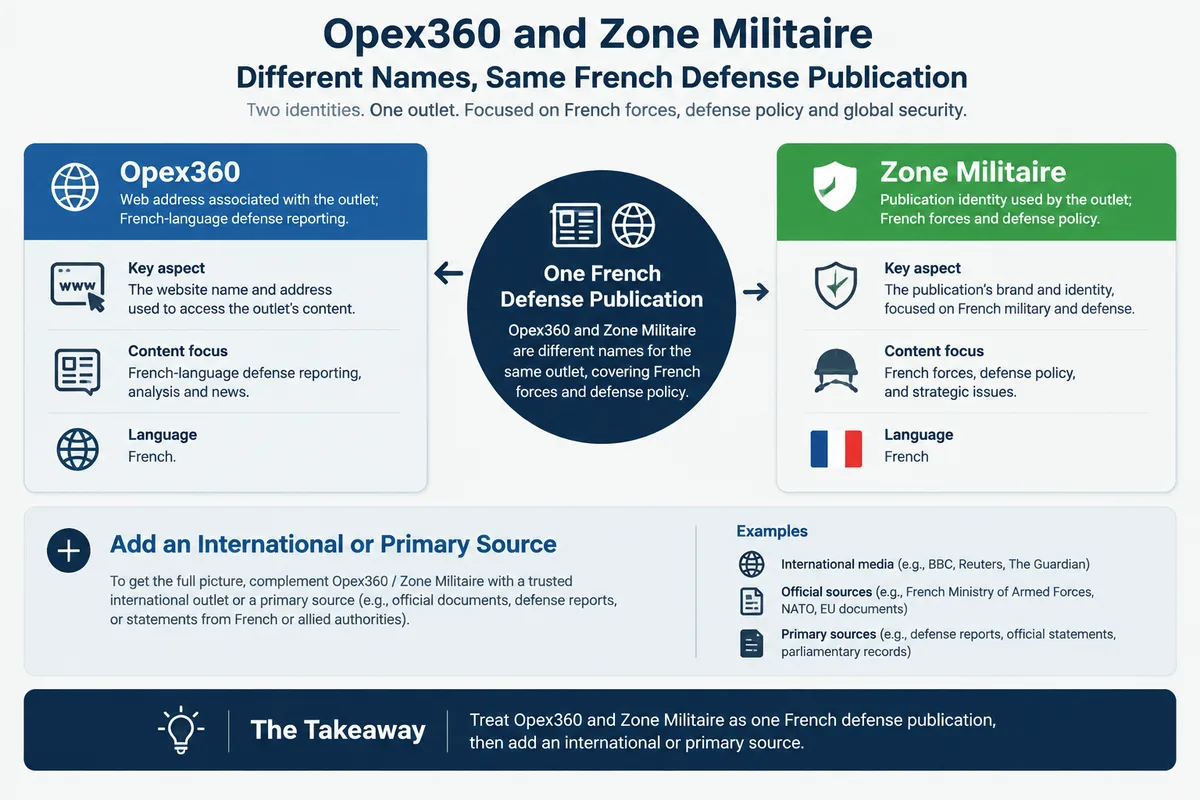
Opex360 is the web address and Zone Militaire is the publication identity associated with the same French-language defense outlet, rather than two independent newsrooms to rank against each other. Its coverage follows the French armed forces, overseas deployments, procurement choices, defense policy, European security, and the companies supplying French programs.
Its reporting is especially useful when a story concerns the French Army, Navy, Air and Space Force, the DGA, overseas operations, force-structure decisions, or French defense companies. French-language reporting can preserve operational and political context that receives less space in English-language coverage.
Opex360 and Zone Militaire are one publication identity, not two rival sources. That distinction prevents a false comparison in which the same newsroom is counted twice. International readers who want the outlet’s background can consult this [Opex360 defense news website](https://www.country-dialing-codes.net/safety/openx360) overview before comparing its reporting with other publications.
However, its strongest value for a reader outside France is perspective. A French report may foreground national industrial policy, parliamentary debate, French deployments, or European capability choices. An English-language industry publication may foreground export competition, multinational procurement, or the effect on allied markets.
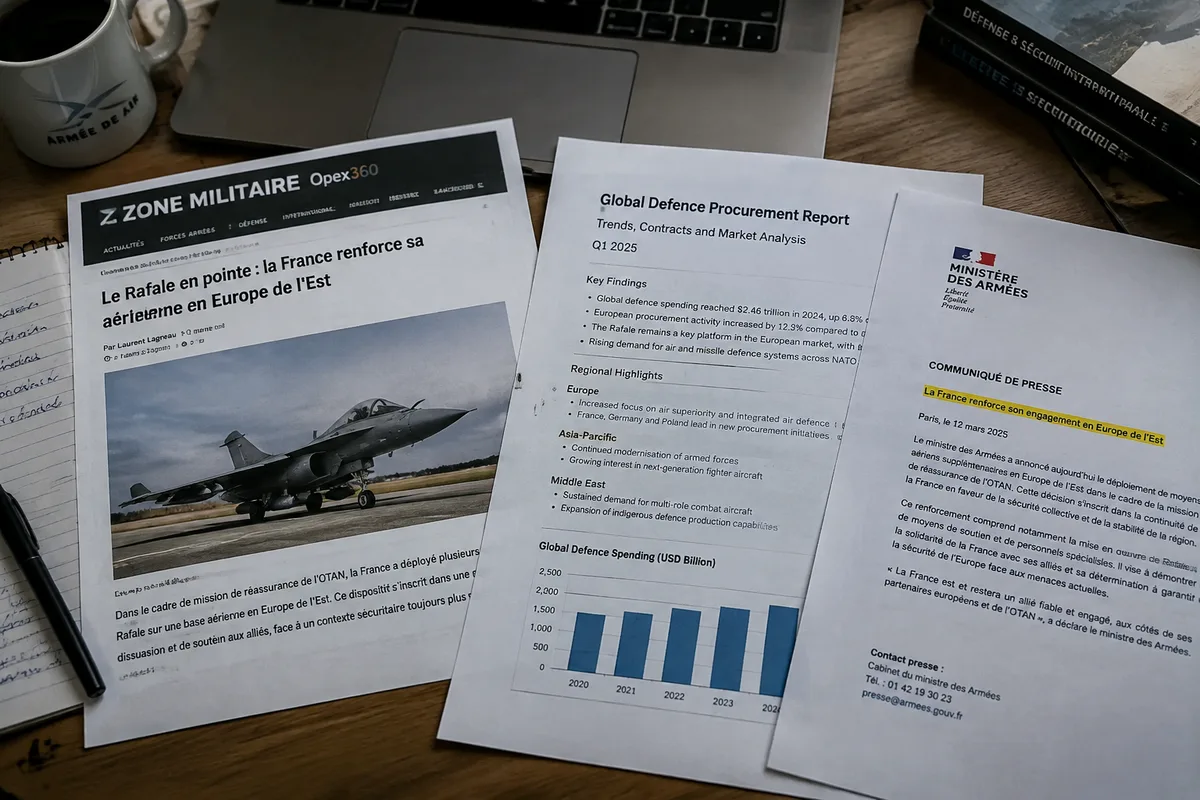
Check the fallback. Pair a French report with a French ministry release, procurement document, or official armed-forces statement when the date, contract status, or institutional position matters.
This pairing also helps with translation risk. A translated term can flatten the difference between an announced intention and an authorized programme. The French original may preserve the institutional wording that determines whether equipment is funded, ordered, tested, or merely discussed.
Defense News: the reference point for procurement and the defense industry
Defense News focuses on acquisition programmes, defense companies, equipment contracts, national budgets, export campaigns, and senior policy decisions. It is particularly useful for the United States, NATO members, allied markets, and major programs in Europe, Asia, and the Middle East, where industrial competition often matters as much as battlefield performance.
Procurement reporting rewards careful reading. An article may mention a requirement, a planned purchase, a signed award, funded production, delivery, testing, or operational fielding. Those stages are not interchangeable. A contract can exist before a vehicle reaches a unit, and a delivered system can remain outside operational service while training or integration continues.
Defense News is the right first stop for an acquisition story. Use it when the central issue is who is buying, who is supplying, how a programme is funded, or how an export campaign affects an industrial market.
Company statements and government announcements carry a different evidentiary weight from independently reported details, even when they appear in the same article. A manufacturer can describe a system’s intended capability. A contract notice can establish an award. An operational report may still be needed to show whether the system has reached users.
But commercial reporting has a blind spot: the market can dominate the operational question. A reader looking for battlefield effect should add technical assessment or service-level evidence. A reader studying industrial policy should retain the commercial context instead of treating it as promotional noise.
- Mark whether the story concerns an announcement, award, option, delivery, test, or deployment.
- Identify the buyer, prime contractor, subcontractors, funding authority, and affected service.
- Look for the difference between a company claim and an independently documented result.
Price changes at borders, and procurement meaning changes between countries. An export campaign in one market may involve different approval rules, local production obligations, weapons configurations, or political conditions in another.
Other military news sources to use by reporting need
The best alternative depends on the reader’s reporting need: rapid policy coverage, technical platform detail, conflict analysis, land-systems reporting, or structured defense intelligence. Breaking Defense, Defense One, Janes, The War Zone, and Army Recognition occupy different positions, so choosing between them requires a subject rather than a popularity contest.
Breaking Defense and Defense One for policy, Pentagon, and NATO decisions
Breaking Defense tracks U.S. defense policy, Pentagon programs, congressional decisions, military technology, and allied security issues. Defense One places military developments within national-security policy, government decision-making, cyber issues, emerging technology, and strategic debate.
Both outlets are most useful when the question is why a budgetary or political decision matters. They can connect a program to institutional priorities that a platform-focused article leaves in the background.
Yet neither should replace the document behind a formal decision. Check the fallback. For a claim about funding, policy, or authorization, locate the budget record, hearing, release, or official statement that supports the article’s interpretation.
Janes for structured intelligence and capability research
Janes combines news with reference material on platforms, force structures, military capabilities, programs, and international security developments. Its professional orientation makes it useful for identifying equipment variants, unit inventories, program timelines, and defense-market context, although subscription access can limit what casual readers can inspect.
Its value lies in structure. A platform name may refer to several configurations, operators, upgrade standards, or production blocks. A specialist reference source can prevent a broad headline from being mistaken for a precise capability assessment.
The War Zone and Army Recognition for equipment and operational developments
The War Zone is known for detailed reporting on aviation, weapons, conflicts, maritime systems, and emerging military technology. Army Recognition concentrates on land-warfare systems, defense exhibitions, equipment announcements, and international industry developments.
Technical reporting becomes stronger when the reader checks the underlying military release, procurement document, imagery, or manufacturer material that establishes formal status. A dramatic photograph can show presence. It cannot, by itself, prove readiness, quantity, mission, or performance.
| Reporting need | Useful source | What it adds | Limit to check |
|---|---|---|---|
| French defense | Opex360 / Zone Militaire | French operational and policy context | French-language and national perspective |
| Procurement and industry | Defense News | Contracts, budgets, companies, exports | Commercial framing can dominate |
| U.S. policy | Breaking Defense | Pentagon, Congress, programs, allies | Confirm formal decisions in documents |
| Strategy and national security | Defense One | Policy consequences and debate | Separate analysis from reported fact |
| Capability research | Janes | Platforms, inventories, timelines | Access may be restricted |
| Equipment and conflict technology | The War Zone | Air, sea, land, space, and weapons detail | Imagery and claims need corroboration |
| Land systems | Army Recognition | Vehicles, exhibitions, announcements | Manufacturer claims need context |
How to build a reliable military news reading stack
A reliable reading stack starts with a specialist report, adds a second perspective with a different national or commercial position, and ends with a primary document for the formal decision or data point. This sequence works because each layer answers a different question: what happened, how others interpret it, and what the institution actually recorded.
Use the stack differently for procurement and operations. For a major acquisition, follow the path from requirement to budget approval, contract award, production, delivery, and operational deployment. For an operation, separate confirmed official facts from battlefield claims, imagery-based assessments, analyst interpretation, and forecasts.
Start with the question, then choose the source. A long undifferentiated list of defense websites produces noise. A short stack organized by topic produces traceable evidence.
- Step one — locate: find the first credible report and record its publication time.
- Step two — classify: mark it as reporting, official material, analysis, opinion, or sponsored content.
- Step three — compare: seek a second source with a different institutional or geographic position.
- Step four — anchor: locate the primary document, contract notice, budget record, or official statement.
- Step five — recheck: look for corrections, updated wording, changed claims, or later confirmation.
In a conflict, do not treat speed as proof. A live feed can identify an allegation quickly while lacking the evidence needed to establish location, timing, or responsibility. Images require attention to date, geolocation, weather, metadata, and possible reuse.
Check the fallback. When a report makes a precise claim about a system or operation, search for the underlying document before repeating the claim as established fact.
For readers focused on emerging systems, this [newest military technology](https://www.country-dialing-codes.net/safety/newest-military-technology-currently-in-operation) resource can sit beside specialist reporting, provided the technology’s operational status is checked rather than inferred from a prototype announcement.
That reading discipline matters because military information can serve influence campaigns. A genuine photograph may be paired with a false date. A real official statement may be quoted without its limiting language. An anonymous account may recycle an older event during a new crisis.
Read the nominal route first. Then test the degraded route: missing context, delayed confirmation, translation error, altered image, or a source that disappears behind a paywall. Where does it fail? Usually at the point where an assumption replaces evidence.
Primary sources that anchor military news reporting
Defense ministries, armed forces, procurement agencies, parliamentary documents, budget records, contract notices, and corporate filings form the official record behind many military stories. They are strongest for formal dates, named contracts, approved budgets, declared deliveries, institutional positions, and the wording of an authorization.
Official material still has a defined purpose. A ministry release may confirm what the institution wants to announce, while omitting disagreement, operational uncertainty, or industrial difficulty. A company filing may disclose a financial obligation without explaining its military effect.
Primary evidence establishes the record; journalism explains the significance. Removing either layer leaves the reader with a document that may be accurate but opaque, or an interpretation that may be persuasive but difficult to verify.
Parliamentary hearings and budget documents can expose funding constraints, delays, trade-offs, and capability gaps before a headline summarizes them. Contract notices can clarify whether a program is funded or merely proposed. Corporate filings can show whether a statement concerns an order, an option, or expected future revenue.
And official websites sometimes contain material with different status labels. A press release, a transcript, a live event, a fact sheet, and a simulated response do not carry the same evidentiary meaning. Read the page type before extracting a sentence.
When the claim concerns orbital systems, attribution matters especially. Two concordant sources report that the Space Force has weapons in orbit, yet the reader still needs to distinguish a reported capability from the mission, readiness, location, and legal interpretation attached to it.
Or a source’s authority does not transfer automatically from one subject to another. A strong procurement outlet may be less useful for local military-community reporting. A ministry may be authoritative about its own announcement and incomplete about an adversary’s losses.
Which military news source should you choose?
Yet the reader’s geography remains decisive. English-language military news often centers on the United States, NATO, and allied defense markets. Regional-language reporting can reveal local political assumptions, domestic procurement debates, and operational details that international outlets compress or omit.
Paywalls, language barriers, geographic restrictions, newsletters, and video formats also change access. A newsletter is a delivery channel, not automatically a separate editorial standard. A video can contain original reporting, commentary, or a simple reading of other people’s work. Inspect the byline, date, labels, correction practice, and source trail.
Check the fallback. If access blocks the decisive paragraph, locate the primary document or a second report that states the same point with visible sourcing.
Frequently Asked Questions
Is Military.com a reputable news source?
Military.com is a military information platform with news, service coverage, gear material, and community-oriented content. Assess each article separately by checking its author, publication date, sourcing, corrections, and whether the page is editorial, commercial, or sponsored.
Which military branch has the most female service members?
The answer requires a defined measure, such as active-duty headcount, reserve personnel, percentage of the branch, or a particular country and year. A branch cannot be ranked responsibly without those boundaries and a current official personnel table.