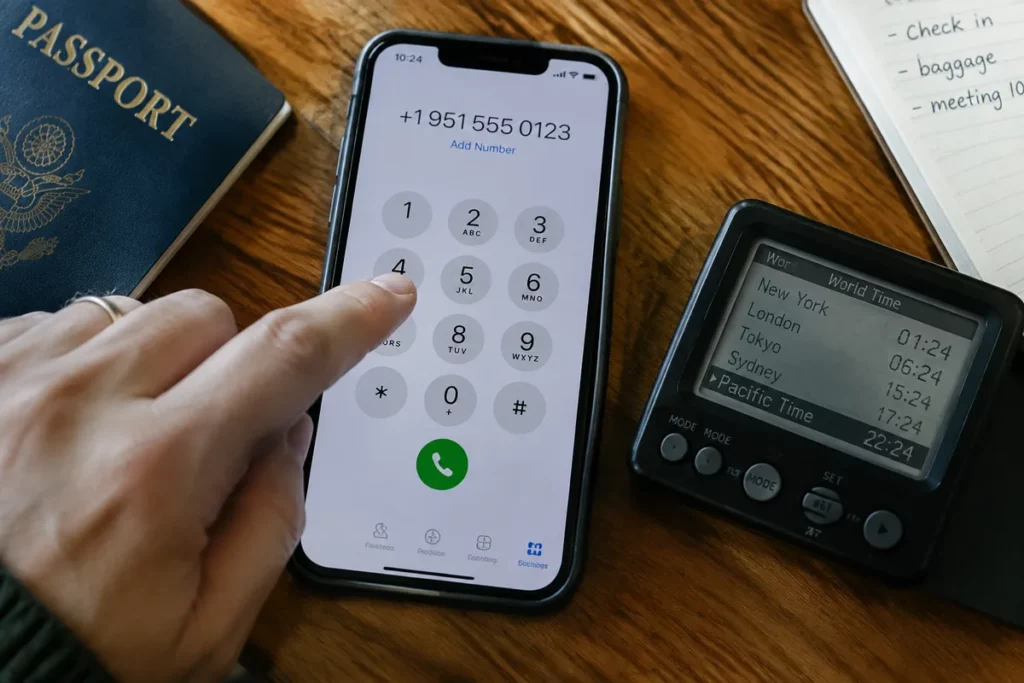
Before you dial, area code 951 is associated primarily with western Riverside County, California, and uses Pacific Time: PST during standard time and PDT during daylight saving time. Dial domestically with the 10-digit format 951-XXX-XXXX; from outside the North American Numbering Plan, use +1 951 XXX XXXX.
The practical risk is a failed handoff between a phone, a carrier, and a numbering plan. A mobile contact usually needs the full area code, while an office system may require an outside-line prefix; international calls add the United States country code and may trigger carrier charges.
| 📍 | Primary area: Western Riverside County and nearby Southern California communities. |
|---|---|
| 🕒 | Time zone: Pacific Time, using PST or PDT according to the season. |
| ☎️ | Domestic format: 951 followed by seven local subscriber digits. |
| 🌎 | International format: +1, then 951, then seven local subscriber digits. |
| 🏢 | Office phones: An outside-line prefix may be required before the number. |
| ⚠️ | Caller ID: A 951 display does not establish the caller’s identity or current location. |
951 area code time zone and service area
Area code 951 uses Pacific Time in California and is generally associated with western Riverside County, including Riverside and nearby communities. The same region follows PST at UTC−8 during standard time and PDT at UTC−7 during daylight saving time, so the displayed local time changes with the seasonal clock adjustment.
951 operates on Pacific Time.
Riverside, Corona, Moreno Valley, Temecula, Murrieta, Perris, Hemet, and Lake Elsinore are commonly associated with the code. These are practical geographic references, not a promise that every street, business, or mobile subscriber in each city uses 951.
The area code describes a numbering assignment area, while a person’s current location can change through mobile use, number portability, or VoIP service. A number originally assigned in Riverside may remain with its owner after a move, and a virtual number may be used far from California.
When Pacific Time changes
California moves its clocks forward by one hour in spring and back by one hour in autumn, which changes the 951 offset from UTC−8 to UTC−7 and then back again. Arizona creates a common comparison trap because most of the state does not follow the same daylight-saving schedule as California.
Eastern Time is three hours ahead of 951 during both standard-time and daylight-saving periods because both regions change their clocks seasonally. A noon call in Riverside therefore reaches an Eastern Time recipient at 3 p.m.
However, the difference with Arizona can change during the year because California changes clocks and most of Arizona does not.
For broader geographic context, the 951 area code location guide can help distinguish common city associations from exact telephone boundaries.
How to call a 951 number from the United States
From a United States mobile phone, enter the complete 10-digit number: 951 plus the seven-digit local number. California uses 10-digit dialing for calls within the 951 region, so the area code remains part of the number even when both callers are in the same county or nearby city.
Use 951-XXX-XXXX.
Mobile phones normally accept the format without a leading 1. Fixed-line, office, and carrier systems can apply a different domestic route, where 1-951-XXX-XXXX is accepted or required as a long-distance access format.
Domestic dialing formats at a glance
The safe starting point for an ordinary domestic call is the 10-digit format, because it preserves the area code and the seven subscriber digits in one complete entry. A leading 1 is a dialing prefix in this context, so it should not be confused with part of the 951 area code itself.
| Calling setup | Entry to try | What to check |
|---|---|---|
| Mobile phone | 951-XXX-XXXX | Use all 10 digits. |
| Residential landline | 951-XXX-XXXX | Try the leading 1 if the carrier rejects the call. |
| Business desk phone | 9, then 951-XXX-XXXX | The office may require an outside-line prefix. |
| Stored contact | 951XXX|||| | Confirm the seven subscriber digits before saving. |
The final row should contain seven actual subscriber digits after 951; the visual placeholder above is deliberately not a dialable number. Remove spaces, hyphens, and parentheses only when troubleshooting the digit count.
Yet a 10-digit entry can still fail when the carrier blocks a call type, the office system expects a trunk prefix, or one digit was copied incorrectly. The carrier and device decide the route.
A common belief says that a caller inside the same city can omit 951. California’s 10-digit dialing requirement makes that shortcut unreliable. Keep the area code in the contact.
How to call a 951 number from another country
From outside the North American Numbering Plan, enter +1 951 XXX XXXX on a mobile phone or service that accepts the plus sign. The 1 is the United States country code within the NANP, while 951 is the California area code and the remaining seven digits identify the subscriber.
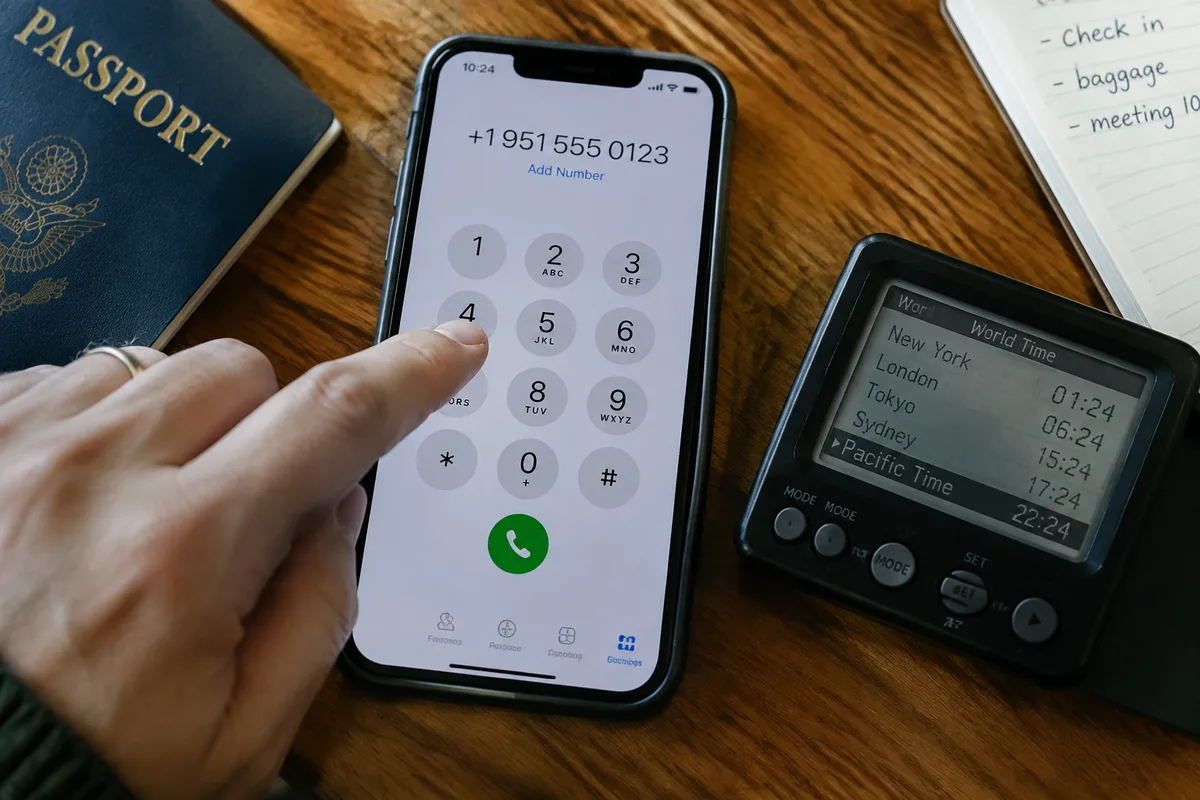
Store the contact as +1 951 XXX XXXX when the person may travel, because the plus format lets the device apply the local international exit route. Do not add a zero before 951.
Examples of international number entry
The complete international number contains 11 digits after the plus sign: 1, 951, and seven local digits. Hyphens and spaces improve readability; they do not add digits.
- Open the contact field. Start with the plus sign if the device supports it.
- Enter the country code. Add 1 for the United States.
- Enter the area code. Add 951 without a leading zero.
- Enter the subscriber number. Add the remaining seven digits and verify them.
- Check the carrier route. Confirm that international calling and the required plan are active before placing the call.
If the plus sign is unavailable, use the international exit prefix assigned by the country where the call starts, followed by 1 and the full 10-digit United States number. The correct exit prefix belongs to the originating country, not to California.
International calling rates, roaming charges, and carrier permissions control the cost or availability of the call. Price changes at borders: a domestic plan can become an international or roaming event after the device registers on another network.
For the wider procedure, these international calling instructions cover the difference between mobile and landline routes.
Office phones and failed 951 calls: the practical fallback
A business phone may need an outside-line prefix before the complete 951 number, and an extension usually belongs after the main call connects or inside a system-specific pause sequence. When a call fails, check the digit count, the office route, and the carrier permission in that order.
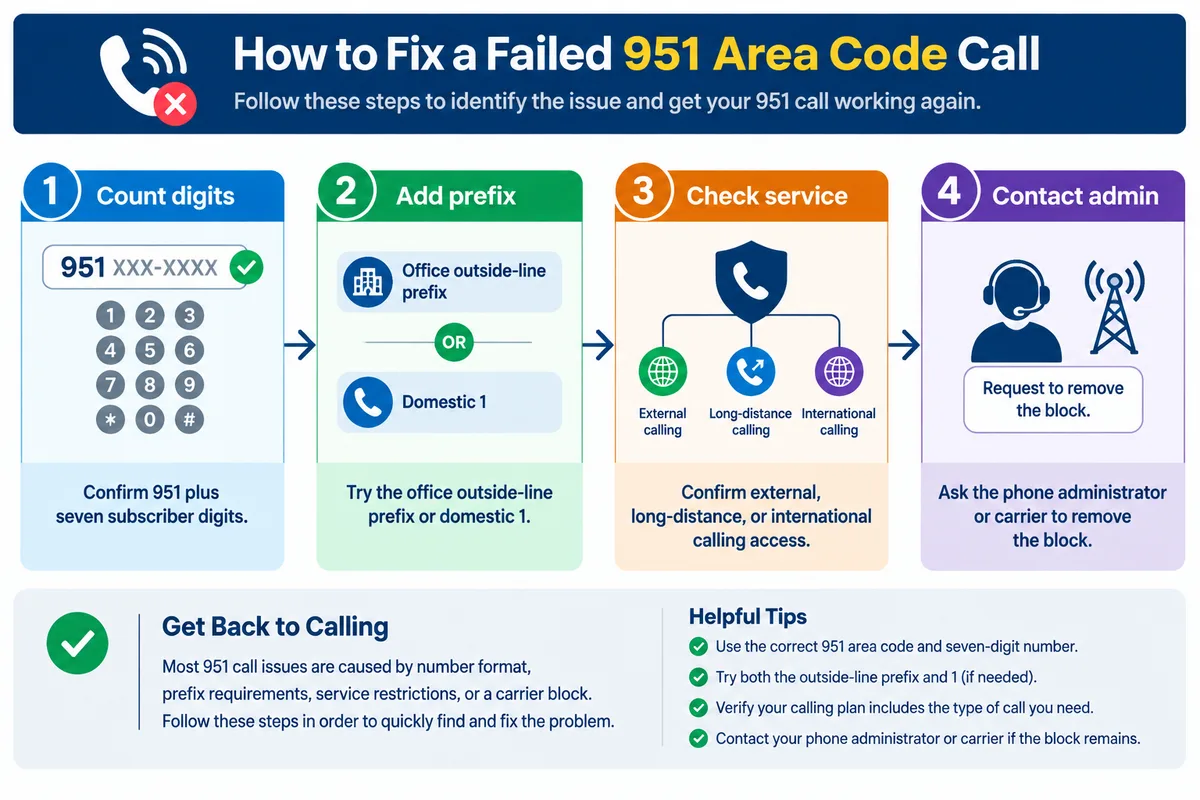
Check the fallback.
Do not treat a 951 caller ID as proof that the person is in Riverside. Caller ID can be altered, and number portability or VoIP can separate the displayed area code from the caller’s present location.
For companies choosing a local presence, 951 business phone numbers address the separate question of local-number setup rather than ordinary dialing.
The 951 code is geographic rather than toll-free. Toll-free codes use separate numbering ranges, so a 951 call may be billed according to the caller’s plan and route.
Final verification before you place the call
For a wider lookup covering location, cities, time zone, and dialing context, consult this 951 area code lookup after the immediate call has been verified.
Frequently Asked Questions
Can a 951 number receive text messages?
A 951 area code does not indicate whether a number supports SMS or MMS. Messaging depends on the line type and carrier: mobile numbers generally support texting, while landline and some VoIP numbers may not.
Can you call 911 from a 951 number?
Yes, a phone with a 951 number can place a 911 call if it has access to a mobile or landline network. Emergency call routing is based on the caller’s current location and network information, not simply on the 951 area code.