Before you dial, a 951 area code business phone number can create a familiar Inland Empire presence, but the right setup depends more on where and how your team answers calls. A business can obtain a 951 phone number through a cloud or VoIP business phone provider by selecting United States, California, and area code 951. Compare number availability, monthly pricing, porting, SMS/MMS, call routing, integrations, and compliance before choosing a provider.
The 951 area code is mainly associated with Riverside County communities such as Riverside, Corona, Moreno Valley, Temecula, Murrieta, and Perris. That local identity helps a service business appear recognizable in listings, advertising, callbacks, and saved contacts. It does not establish a physical office. The phone system behind the number determines whether calls reach a receptionist, a shared queue, a mobile app, or nobody during an outage.
| Key point | What it means for a business |
|---|---|
| 📍 Geographic identity | 951 is associated primarily with Riverside County and the Inland Empire. |
| ☎️ Acquisition | Cloud, VoIP, virtual, landline, cable, and wireless providers may offer different ways to use the number. |
| 👥 Team control | Queues, extensions, permissions, and shared voicemail matter when several employees answer calls. |
| 💬 Messaging | SMS/MMS availability depends on provider support, registration, consent, and business use. |
| 🔁 Porting | An existing number may be transferable when the new carrier accepts it and account details match. |
| 🛟 Continuity | Fallback routing protects customer access when broadband, power, or a primary device fails. |
What does a 951 business number signal to Inland Empire callers?
A 951 business number signals a local calling presence connected with Riverside County and nearby Inland Empire communities. The area code is linked with Riverside, Corona, Moreno Valley, Temecula, Murrieta, and Perris, while the number itself says nothing about the company’s office address, staff location, or service quality.
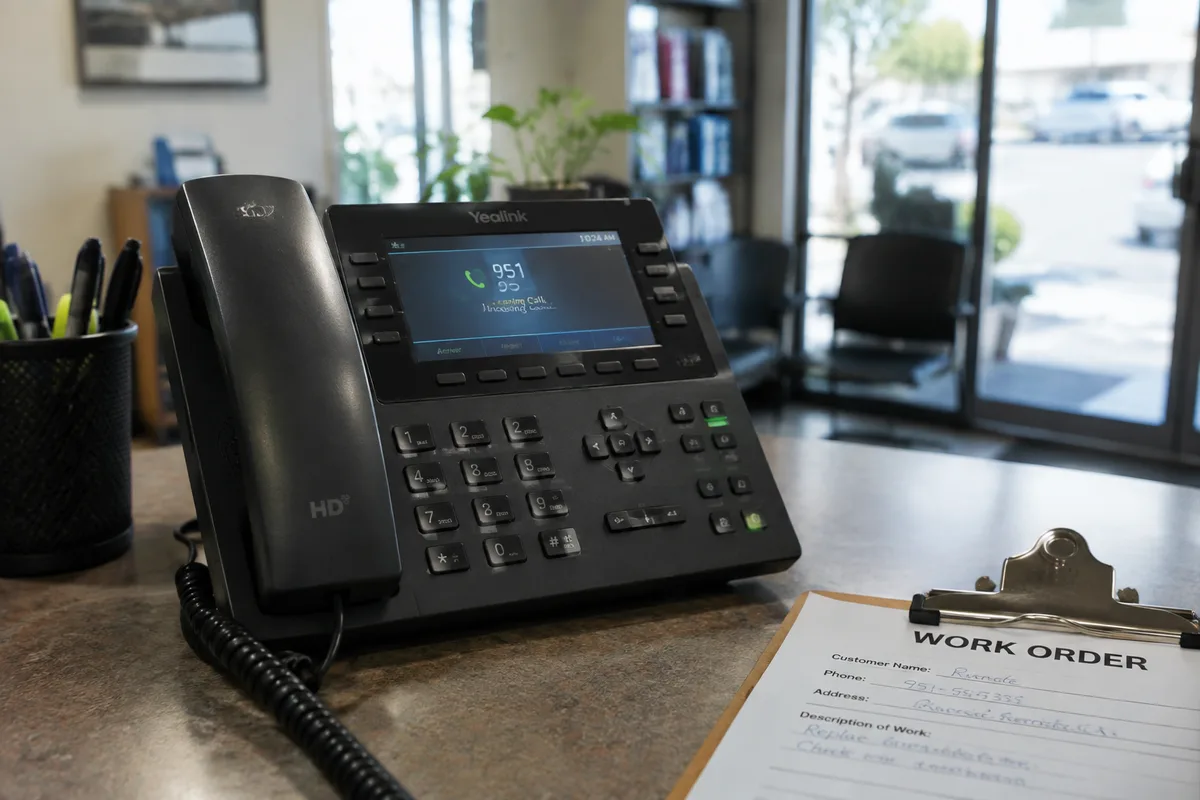
Local recognition is useful when customers decide whether to answer, call back, or save a number. A company serving Riverside County can use the same identity across search listings, paid ads, vehicles, invoices, appointment reminders, and outbound calls.
However, an area code is a geographic numbering label, not a trust certificate.
Some callers say, “A local number means the business is local.” That shortcut breaks quickly because numbers can be assigned to cloud platforms, moved between carriers, kept after relocation, or displayed through caller-ID spoofing.
Thus, a 951 number can support local positioning without making a physical-office claim. The caller still needs a reliable business name, consistent callback path, and clear service information.
The 951 area code was separated from 909 in the area-code history described by several published guides. Those guides differ on whether the relevant milestone should be described as July 17, 2004, or simply 2004, so the month and day should not be treated as an independently verified regulatory date here.
The 442 overlay covers the same broad geographic territory, which means a newly assigned local number may use 951 or 442. Area-code selection therefore affects local presentation, while inventory determines what a provider can actually issue.
What are the four ways to get a 951 business phone number?
A business can use a 951 number through fixed-site service, hosted VoIP, a virtual phone system, or a dedicated wireless line. The practical distinction is where calls ring, who can answer them, and whether the company controls routing, messaging, records, and administrator access.
Fixed-site landline and cable phone service
Traditional landline or cable service suits a permanent office with a reception desk, desk phones, and equipment tied to one location. Installation, building wiring, bundled internet, and local support shape the setup more than the area code itself.
Reception-style calling remains straightforward.
A fixed line can work well for a clinic, workshop, warehouse, or office where the first answer happens at one desk. Legacy fax, alarm, elevator, or analog equipment may also influence the decision, although compatibility must be confirmed with the carrier and equipment vendor.
Advantages
- Familiar desk-phone workflow
- Suitable for a permanent reception site
- Less dependence on employee mobile devices
- Useful where legacy equipment remains important
Drawbacks
- Lower mobility for remote staff
- More location-dependent installation
- Fewer shared-routing tools on basic plans
- Continuity may require a separate backup path
But a fixed number does not automatically provide modern team controls, and a desk phone cannot answer a broadband outage by itself.
Hosted VoIP, virtual systems, and mobile lines
Hosted VoIP combines a 951 number with internet calling, extensions, queues, auto attendants, and administrative controls. Virtual systems send calls to an app, browser, or existing mobile device, while dedicated wireless lines give field staff a separate number carried through a cellular network.
Cloud access changes the handoff.
Hosted VoIP fits growing offices and distributed teams that need shared answering rules. A virtual system fits a solo consultant or small shop that wants a business identity without buying desk phones. A wireless line fits a technician or owner whose primary workplace is the road.
Cloud and app-based options rely on the quality of the internet or cellular network. A device may show strong signal while the user is unavailable, logged out, on another call, or outside the intended coverage area.
Which business features change the value of each option?
Shared-call controls determine whether a 951 number remains useful as staff, locations, and schedules change. Extensions, ring groups, queues, shared voicemail, texting ownership, caller-ID consistency, and emergency-address management carry more weight than a low entry price once several people handle customer calls.
Shared-call controls for teams
A shared business line keeps customer conversations attached to the company rather than one employee’s personal device. Queues and ring groups can distribute calls by department, schedule, availability, or escalation order.
One person should not own the whole workflow.
- Extensions: route callers to people or departments without publishing personal numbers.
- Ring groups: alert several approved users in a defined order or at the same time.
- Shared voicemail: keeps messages accessible when the usual recipient is absent.
- Administrator permissions: retain routing, recordings, numbers, and user control inside the business.
- Business-hour rules: send after-hours calls to voicemail, an on-call person, or an answering route.
Moreover, administrator access matters during employee turnover. If one salesperson controls the only login, number ownership and customer access become fragile.
Mobility, texting, and call quality
Mobile-first teams benefit from simultaneous ringing and app access across phones and computers, while texting can support appointment updates, customer questions, and photo attachments when the provider permits those functions.
Texting is not automatically ready on every number.
Commercial messaging requires consent, appropriate opt-out handling, and provider-specific registration or review. The Telephone Consumer Protection Act, 47 U.S.C. §227, and FCC rules at 47 C.F.R. §64.1200 are relevant legal references for U.S. calling and messaging practices; the business remains responsible for its campaign design and records.
Signal quality remains operational, even for a cloud plan. Stable broadband, Wi-Fi design, cellular coverage, device permissions, and outage routing determine whether a customer reaches a person or hears silence.
Caller ID also needs checking. STIR/SHAKEN authentication requirements under 47 C.F.R. §§64.6300–64.6305 affect how providers validate outbound caller identity, but a verified display does not guarantee that every recipient sees the preferred business name.
For CNAM, ask the carrier how the business name is submitted, updated, and displayed across receiving networks. Spam filters use reputation signals, complaint patterns, calling behavior, and authentication; the 951 label alone cannot secure favorable treatment.
identify a legitimate 951 call through the caller’s stated business, known callback channel, and independent contact details rather than the area code alone.
How do 951 number options compare by cost, mobility, and control?
The cheapest advertised plan is not automatically the lowest-cost business setup. Compare monthly users, activation, equipment, contracts, cancellation, texting, number ownership, support, and fallback routing before assigning a 951 number to customer-facing work.
| Option | Cost factors | Mobility | Control and features | Best fit |
|---|---|---|---|---|
| Landline or cable | Installation, equipment, bundled service, site charges | Low | Familiar desk calling; routing depth varies | Permanent office with reception |
| Hosted VoIP | Per-user licenses, setup, hardware, optional features | High | Strong queues, extensions, permissions, analytics, and integrations | Growing or distributed teams |
| Virtual phone system | Subscription, user seats, messaging, add-ons | High | App and browser access with limited hardware needs | Solo businesses and small shops |
| Dedicated wireless line | Line plan, device, cellular usage, add-ons | Very high | Separate mobile identity; fewer central team controls | Field employees and owner-operators |
| Toll-free number | Number charges, minutes, messaging, provider fees | High | Broad geographic positioning rather than local identity | Regional or national support |
| Existing-number port | Provider fee, account cleanup, temporary forwarding | Depends on destination | Preserves public recognition when accepted | Established businesses with printed contact details |
Comparison criteria that matter before purchase
Start with number inventory and total cost, then test the workflow. A provider that has a 951 number today may not offer the same inventory, feature bundle, or activation path when the order is placed.
Prices must be dated.
A Dialpad listing dated June 7, 2024 showed a Standard plan at $15 per user per month and a Pro plan at $25 per user per month, alongside an advertised 14-day trial; these are historical commercial claims, not confirmed 2026 prices.
Aircall and other cloud providers publish their own feature and integration claims, but promotional counts do not replace a check of the specific plan. One Aircall page stated support for more than 100 integrations and claimed use by more than 23,000 companies; those figures describe the provider’s marketing position, not a guarantee for every account.
Use this purchase checklist:
- Can the provider issue a 951 number now?
- Is the number local, mobile, virtual, or toll-free?
- What are the monthly user, activation, equipment, and cancellation charges?
- Can the account send SMS/MMS, and what registration is required?
- Can the company export contacts, call records, recordings, and messages?
- Who can change routing when the original administrator leaves?
- What happens during broadband, power, app, or carrier failure?
For overseas callers, the format is +1 951 XXX XXXX. A Localphone listing supplied for this comparison showed $6.00 in setup and $3.00 per month for an incoming 951 number, with an advertised France-to-U.S. rate starting at 2.9 cents per minute; these are provider-specific prices and must not be treated as universal international charges.
How can you activate the number without losing business continuity?
Activation is safe when the business decides between a new 951 number and a ported number, keeps the old service active during transfer, and prepares an alternate destination before publishing the new contact. The public number and the answering path must change in a controlled sequence.
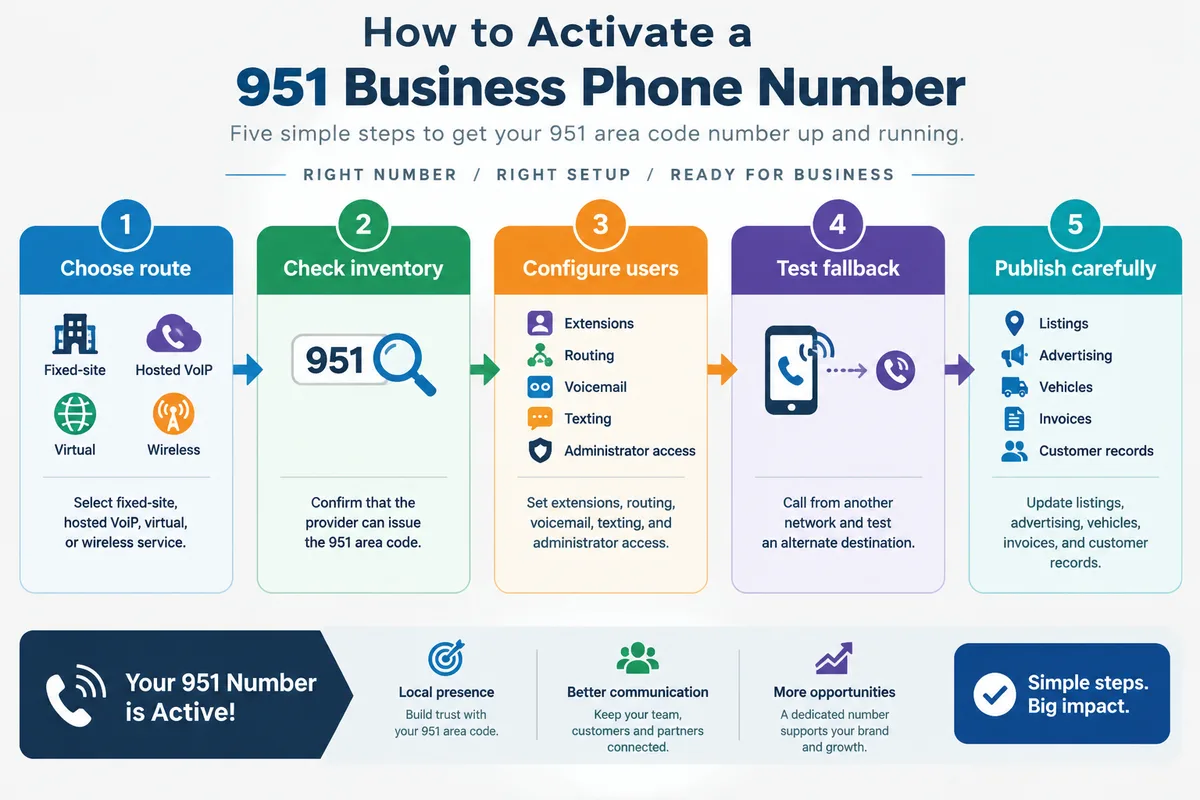
New 951 number or existing-number port?
Choose a new number when local recognition is the goal and no established contact number needs to remain public. Port an existing number when customers already use it on signs, websites, directories, vehicles, invoices, or advertising.
U.S. number portability rules include carrier obligations described at 47 C.F.R. §52.34. The new provider normally needs matching account information, the existing service must remain active, and the number must be eligible for transfer under the provider’s service area and technical conditions.
Do not cancel the old line first. A temporary forwarding path can preserve inbound access while listings and routing move, although forwarding charges and timing depend on the providers.
Check the fallback.
Caller ID and outage planning
Set outbound caller ID to the main business identity, then test return calls from mobile, landline, and different carrier networks. A customer should reach the intended team rather than an employee’s private voicemail.
One test call is not enough.
Run a short failure drill:
- Disconnect the primary broadband connection or disable the main app device.
- Call the published 951 number from an unrelated network.
- Confirm the alternate person, mobile line, voicemail, or answering service receives the call.
- Restore the primary route and confirm normal call handling.
Emergency calling needs separate attention. Kari’s Law and the RAY BAUM’S Act are referenced in 47 C.F.R. §9.16, which addresses emergency calling capabilities and location information for covered interconnected services. A cloud user should record the service address, remote-site procedure, and administrator responsible for updates.
Check the fallback. A backup route is useful only when someone answers it.
Number ownership and post-cancellation risk
Keep the account in the company’s legal name, store administrator credentials securely, and document the porting authority. A number can be valuable because customers remember it, not because the monthly plan is expensive.
Cancellation creates a separate risk.
Portability can allow an account holder to retain a number with a new operator, while the supplied material does not establish a universal recovery period after cancellation or a single recycling timetable. Ask the current provider about the exact cancellation date, quarantine period, recovery rights, and port-out process before closing the account.
Where does it fail? It fails when the company cancels first, loses account credentials, or assumes a recycled number will remain recoverable.
Which 951 business number setup fits your company?
Here is the practical verdict by profile:
- Fixed office: choose landline or cable service when desk phones, reception, and permanent equipment dominate the workflow.
- Growing team: choose hosted VoIP when extensions, queues, business-hour routing, and administrator control matter.
- Solo consultant: choose a virtual 951 number when calls should reach an app or browser without exposing a personal number.
- Field-service crew: choose a dedicated wireless line or cloud app when technicians answer away from a desk.
- Regional support operation: compare a local 951 number with a toll-free number when customers come from outside Riverside County.
A local 951 number suits a Riverside County service area. A toll-free number suits broad geographic reach. An existing number deserves priority when customers already know it.
That distinction prevents a common purchase error: treating local presence as the only objective. A plumbing company sending technicians across Riverside County may value mobile handoff more than a desk phone. A law office with reception and fixed records may value controlled answering more than app flexibility. A national software company may need toll-free access alongside a local sales number.
However, a local number does not replace a service model. The right choice follows team size, call volume, work location, shared-feature needs, and continuity requirements only if the carrier’s plan supports the way customers actually reach the company.
For a deeper look at the area’s cities, time zone, and dialing format, see this 951 area code location guide. When calls cross borders, the international format and the receiving carrier’s charges deserve a separate check.
Frequently Asked Questions
How do I find the prefix for a 951 phone number?
The prefix is the three digits immediately after the 951 area code in a number formatted as 951-XXX-XXXX. It cannot be identified from the area code alone because each prefix is assigned separately to a carrier or geographic rate center.
Can a business have multiple 951 numbers on one phone system?
Yes, a provider can assign multiple 951 numbers to the same business phone system when inventory and the selected plan allow it. Each number can be routed to a different department, location, campaign, employee, or shared call queue.