In 3 checks, you can usually determine whether your phone will work abroad: confirm that your plan covers the destination, verify that your phone can use a compatible foreign network, and review the exact roaming rates before departure. Phone roaming abroad may support calls, texts, and mobile data, but each service can carry separate conditions and charges.
International phone roaming lets your home carrier authenticate your SIM while a foreign network provides service. The practical risk begins when a phone connects automatically, uses background data, or reaches a network excluded from the plan without making the cost obvious.
Quick facts
📱 Roaming abroad can include calls, voicemail, texts, and internet access, with separate billing rules for each service.
🌍 Destination, carrier, and device compatibility determine whether your phone connects and whether usage is included.
🔒 Turning off data roaming limits foreign cellular data on that line, but calls, texts, voicemail, or another active line may still create charges.
🧾 Check the exact destination terms before leaving, then monitor both the carrier account and the phone’s data counter.
What happens when your phone roams on a foreign network
Phone roaming abroad is a mobile service arrangement that allows your home carrier to authenticate your SIM while a partner network in another country handles the radio connection. Or, the phone may register automatically when roaming is enabled, a compatible network is available, and the plan permits international use.
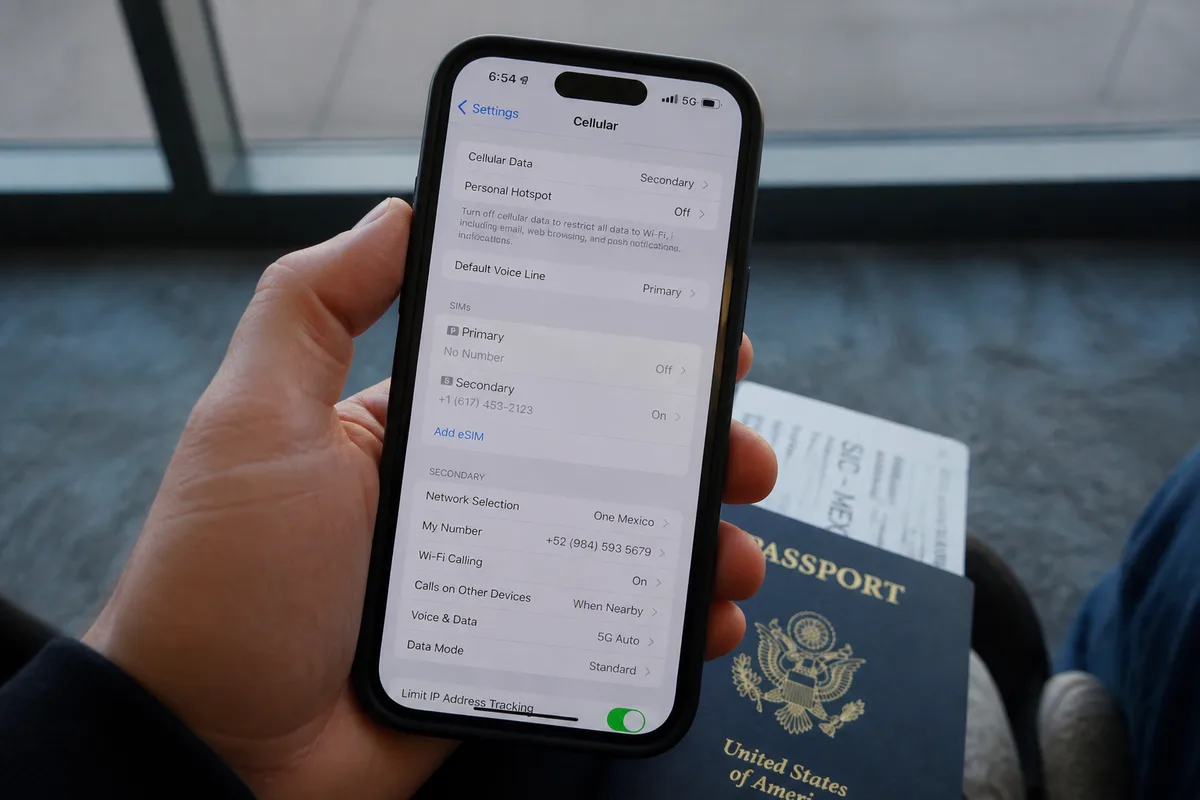
A roaming icon, a new network name, or a carrier welcome message can show that the phone registered outside its home network. None of those signs confirms that the connected usage is included in the plan. The current destination terms remain the billing reference.
Or, a phone can fail to connect when international roaming is blocked on the account, the device is locked, the SIM has restrictions, or no compatible partner network is available. A foreign network may also lack the bands required by the exact phone variant.
Check the model number, not only the phone’s marketing name. An unlocked handset is easier to use with a local SIM or travel eSIM, while dual-SIM phones need a deliberate choice of line for mobile data. U.S.-oriented compatibility checks may include bands 4, 5, 12, 66, and 71, but the destination network and exact device variant decide whether those bands are useful.
Calls, texts, voicemail, and internet access follow different billing paths. A local call, a call back home, a call to a third country, and a premium-rate number may have separate prices. Incoming calls and voicemail retrieval can also create charges under some plans.
Standard SMS is handled differently from picture messages and app messages. Picture messages usually require mobile data, while WhatsApp, iMessage, Signal, and similar services require Wi-Fi or mobile data.
Background activity can consume mobile data without an obvious browsing session. Maps, cloud photo backup, app refresh, operating-system updates, email synchronisation, social feeds, and video autoplay may continue while the traveller is moving between networks.
Or, turning off data roaming normally blocks foreign cellular data on the selected line. Calls, SMS, voicemail, Wi-Fi calling, delayed billing, and another active SIM remain separate checks.
“A roaming connection tells you where the phone registered, not whether the usage is included.”
How roaming charges are calculated
Roaming charges depend on the home carrier, destination, plan, service type, partner-network agreement, and any travel pass or allowance active on the account. Or, the same foreign network can produce very different bills for two travellers whose plans have different destinations, limits, or out-of-bundle rates.
Start with the carrier’s destination-specific terms. A welcome message can identify the network and provide a first warning, yet it may not show renewal timing, fair-use conditions, excluded services, or the rate that applies after an allowance ends.
Inclusive roaming bundles provide a defined allowance in selected destinations. Daily travel passes may charge on days when qualifying use occurs, while monthly add-ons and pay-as-you-go pricing suit different travel patterns.
Spending caps, usage alerts, and throttling can reduce exposure when the provider offers them. Their trigger points and scope are provider-specific, so check whether a cap covers data only or also includes calls, messages, and premium services.
“The decisive number is the out-of-bundle rate for the exact country and service.”
Or, a cruise ship, aircraft, ferry, or remote-area connection may use a maritime, aeronautical, or satellite network outside an ordinary land-roaming package. Automatic selection near a border can also connect the phone to a neighbouring country before the traveller knowingly crosses it.
Voicemail retrieval, call forwarding, hotspot use, multimedia messages, and background synchronisation deserve separate checks. The carrier account, plan terms, and usage record are the places to verify each charge.
For many U.S. customers, a domestic plan does not automatically cover use abroad, according to the FCC’s consumer guidance, updated November 25, 2025. Roaming charges can also appear during an additional billing cycle after the traveller returns because network records may reach the home carrier later.
How to avoid roaming charges before departure and during your trip
The safest approach is to choose the connectivity method before travel, verify the destination terms, and reduce background data before the phone reaches a foreign network. Or, checking costs only after arrival gives automatic updates, backups, and network registration time to create avoidable usage.
Use this pre-departure sequence:
-
Check the destination
Confirm the country, territories, transit stops, and any border crossings covered by the carrier plan.
-
Check the plan
Review activation requirements, daily-pass triggers, included data, fair-use rules, spending controls, and out-of-bundle rates.
-
Check the device
Verify that the exact phone variant is unlocked, supports the destination networks, and accepts the intended SIM or eSIM.
-
Prepare offline access
Download maps, tickets, translations, reservations, and essential media over trusted Wi-Fi.
-
Limit background use
Restrict automatic updates, cloud backups, photo synchronisation, background refresh, and high-data media on the roaming line.
Or, when a dual-SIM phone keeps the home line for authentication texts, select the travel line specifically for cellular data. Enable data roaming only on the line intended to use foreign cellular data.
Airplane mode stops cellular registration while it remains enabled, but Wi-Fi or Bluetooth can be turned back on separately. Use manual network selection near borders, at sea, or in flight when the phone repeatedly chooses an unsuitable network.
Monitor the carrier account and the phone’s own data counter during the trip. Their reporting times may differ, so a recent display does not guarantee that every network record has already reached the billing system.
If an unexpected charge appears, record the date, time, network name, line used, and type of activity before changing settings. Contact the provider promptly and ask whether the usage matches the roaming terms, a travel pass, a delayed record, or a network outside ordinary coverage.
Do not assume a charge is wrong solely because data roaming was off. Calls, voicemail, SMS, delayed reporting, Wi-Fi calling, or another active line may explain the entry.
Carrier roaming, travel eSIM, local SIM or Wi-Fi: which option fits your trip?
Carrier roaming is usually the simplest way to keep a home number active, while a travel eSIM, local SIM card, or Wi-Fi-only setup can provide different levels of cost control and coverage. Or, the lowest advertised data price is the wrong deciding factor when the traveller needs reliable calls, verification texts, or support from the home carrier.
| Option | Best fit | Main advantage | Important limitation |
|---|---|---|---|
| Carrier roaming | Short trips or business travel | Existing number stays active with little setup | Daily fees, limits, exclusions, or out-of-bundle charges may apply |
| Travel eSIM | Data-focused travel across supported destinations | Separate travel data can reduce use of the home carrier’s roaming | Requires eSIM support, an unlocked phone where required, and compatible networks |
| Local SIM card | Longer stays or local service needs | May provide local data, calls, and recharge options | Purchase, registration, top-ups, and number changes can add friction |
| Wi-Fi only | Hotel-based messaging and downloads | Can avoid home-carrier cellular data use | Coverage is intermittent, public networks may be unsafe, and calling support varies |
Choose carrier roaming when keeping the usual number available matters more than minimising every data cost. Choose a travel eSIM when the phone is compatible and the trip needs cellular data without relying on the home carrier’s foreign allowance.
Choose a local SIM card for a longer stay that requires local service or frequent recharges. Choose Wi-Fi-only use when connectivity is needed mainly at trusted accommodation and transport hubs.
Or, a travel eSIM is not automatically cheaper than carrier roaming. Compare the destination, trip length, data volume, taxes, voice needs, coverage, and support before buying.
“Compare the itinerary, not the national coverage map.”
A local SIM or travel eSIM may replace the home line for mobile data while the home SIM remains enabled for one-time passcodes. Calls or mobile data on that home line can still trigger roaming charges, so set the data line explicitly and review automatic switching.
Public Wi-Fi can reduce mobile data use, but it is not automatically private, reliable, or free. Avoid sensitive account activity on unfamiliar networks unless the connection and security controls are appropriate.
For calling home, internet-based calling apps work over Wi-Fi or a separate data connection. Traditional calls and Wi-Fi calling abroad follow carrier-specific terms, including possible emergency-calling and billing limitations; check the provider before relying on them.
Frequently Asked Questions
Phone roaming rules are plan-specific, so the current destination terms from the home carrier remain the final reference for availability and billing. Or, a setting that prevents cellular data does not automatically make every call, message, or connected service free.
Will my phone automatically work in another country?
A phone may connect automatically when international roaming is allowed, the device is compatible, and a partner network is available. Coverage and pricing still depend on the carrier, destination, plan, SIM, and phone variant.
Do I need to turn on data roaming abroad?
Usually, data roaming must be enabled for mobile data on a foreign cellular network. Data roaming is not needed for Wi-Fi, and leaving it off helps prevent cellular data use on that line.
Can I receive text messages without paying for roaming data?
Standard SMS may arrive without using mobile data, but receiving and sending texts follow the carrier’s roaming rules. Internet-based messages require Wi-Fi or mobile data.
Is a travel eSIM always cheaper than carrier roaming?
No. Compare the exact destination, trip duration, data allowance, coverage, taxes, voice requirements, and current carrier terms before choosing.
How can I stop my phone from roaming?
Turn off data roaming, disable the relevant line, or use airplane mode when appropriate. Check the effect on calls, texts, authentication messages, and Wi-Fi for the specific device and plan.
What should I do if I receive an unexpected roaming charge?
Record the date, network, line, and reported usage, then contact the carrier promptly. Ask whether the charge came from data, calls, voicemail, SMS, delayed reporting, a travel pass, or a maritime or satellite network.
Travel checklist
- ✅ Verify the exact destination and roaming terms before departure.
- 📶 Confirm that the phone is unlocked and compatible with the intended network, SIM, or eSIM.
- 🔐 Select the correct data line and disable roaming on any line that should not use foreign cellular data.
- 🧾 Monitor usage and investigate charges using the carrier record, network name, and time of activity.
- 🌍 Compare the full itinerary, including borders, ferries, flights, and multiple countries.
For current conditions, check the home carrier’s destination page, the phone manufacturer’s compatibility information, FCC consumer guidance, and the European Union’s roaming information for travel within applicable EU countries. In another EU country, europa.eu states that calls, SMS, and mobile data are charged at domestic rates under the applicable roaming framework, including received calls and SMS, while separate rules may apply to territories, the United Kingdom, ships, aircraft, and non-EU destinations.
Phone roaming abroad is manageable when the traveller checks the exact plan, controls the active line, and follows the route through every border, network, and connection point. Confirm the carrier terms again before departure if the trip includes 2 or more countries.