In 2026, 011 still works for many international calls from U.S. landlines: dial 011, the destination country code, any required area or city code, and the local number. Mobile phones and many internet-based services usually accept the plus sign instead, such as +44 followed by a U.K. number.
The correct format depends on the network carrying the call, the device, the phone system, and the destination country’s numbering plan. The prefix only starts the international route; international calling permission, roaming status, and carrier charges remain separate checks.
Key Facts
- 📞 U.S. landline format: 011 + country code + national number.
- 📱 Mobile format: + + country code + national number when supported.
- 🌍 Leading zeros: remove one only when the destination’s international format requires it.
- 💳 Cost: 011 and + do not set the price; the carrier, plan, destination, and number type do.
Do You Still Need 011 to Call Another Country From the U.S.?
Or, yes, 011 remains the international access prefix used by many conventional U.S. telephone networks, so a compatible landline normally starts with 011 before the destination country code. A mobile phone, VoIP service, office PBX, or calling application may accept a different entry method.
011 is an international access prefix that tells a U.S. telephone network to route a call outside the country. It is not a country code. The U.S. country code is commonly represented as +1 by international dialing references.
“To call a phone in another country, dial 011, then the code for the country you are calling, followed by the area or city code and the phone number.” — Federal Communications Commission, International Long-Distance Calling Made Simple, reviewed May 7, 2024.
Or use 011 when the U.S. landline or business phone system requires an international access prefix. Use + when the handset or service accepts international-format numbers. Short rule: use the network’s required format.
International calling permission is a separate matter. A correct sequence can still fail when an account blocks overseas calls, a company restricts international destinations, or a prepaid balance is insufficient.
A common assumption says that 011 is the U.S. country code. That confuses two different functions: 011 opens an international route from the United States, while a country code identifies the destination after the route opens.
Or ask where the phone will actually be used. A U.S. SIM roaming in another country uses the visited network, and the visited network may require its own international access method rather than the U.S. landline prefix.
The International Call Format: What Comes After 011 or +
Or the usable sequence is 011, the destination country code, the area or city code when required, and the recipient’s national number; on a supported mobile device, replace 011 with +. The country code identifies the destination, while the remaining digits identify the specific line.
The international format must match the destination country’s numbering plan. A domestic number copied from a local directory may contain a trunk prefix that is not used internationally.
Use the full international number supplied by the recipient or an authoritative numbering reference, rather than converting a domestic number by guesswork.
Or treat the plus sign as a portable international access symbol, not as a replacement for the country code. The complete mobile pattern is +, destination country code, and the national significant number.
The national significant number may contain an area, city, or mobile prefix. Country plans handle those prefixes differently. A leading zero used for domestic calls may need to be removed, retained, or treated in another way.
That decision belongs to the destination country’s numbering rules. The United Kingdom, France, and Australia examples below show why a domestic-looking number should be checked before dialing.
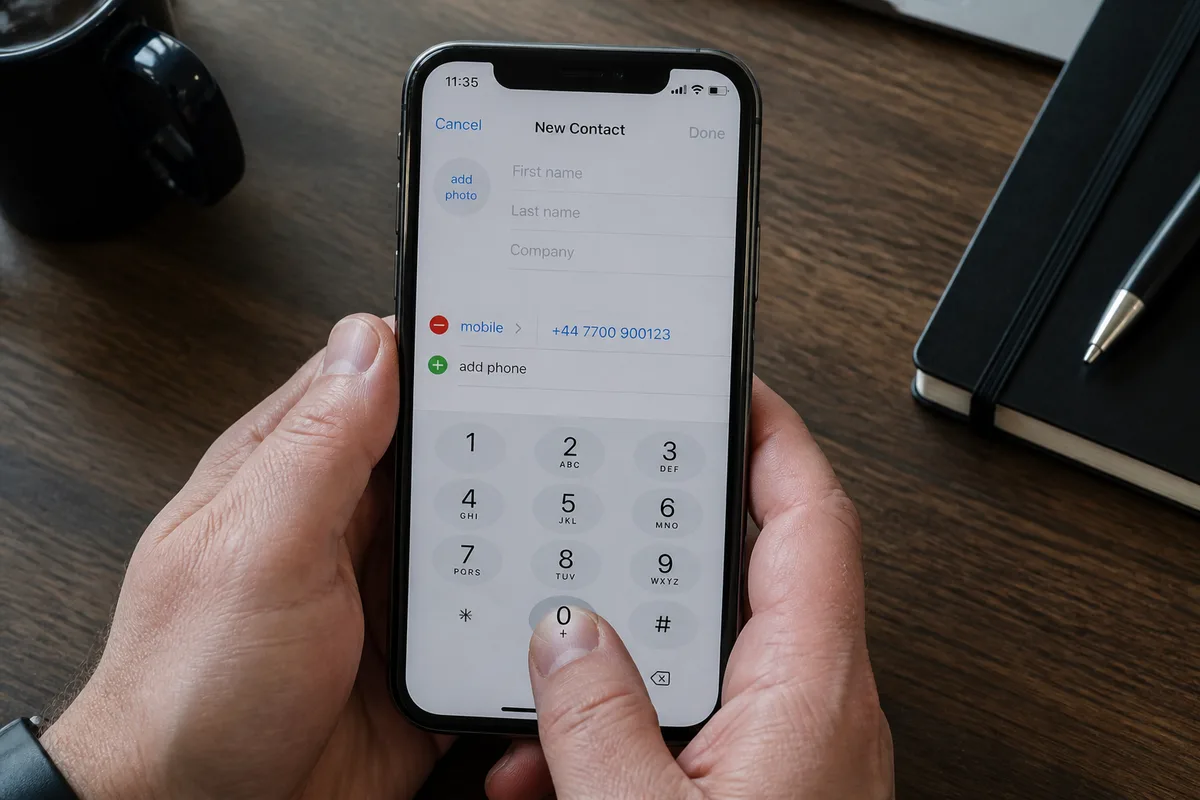
On most smartphones, pressing and holding 0 displays +. The device then stores the number in a format that can remain usable when the phone changes networks or crosses a border.
Or separate number structure from account authorization. The correct country code cannot activate international service, remove roaming restrictions, or change a carrier’s rate for a premium destination.
How to Dial the U.K., France, and Australia From the United States
Or these three examples show the practical difference between domestic and international formatting: start with 011 on a compatible U.S. landline, or use + on a supported mobile phone, then enter the destination number without any domestic prefix that the destination plan excludes.
| Destination | U.S. landline format | Mobile format | What changes |
|---|---|---|---|
| United Kingdom, London | 011 44 20 7123 4567 | +44 20 7123 4567 | The domestic London prefix 020 appears as 20 internationally. |
| France, Paris | 011 33 1 42 68 53 00 | +33 1 42 68 53 00 | The domestic leading 0 is omitted in this international format. |
| Australia, Sydney | 011 61 2 9374 4000 | +61 2 9374 4000 | The domestic 02 prefix appears as 2 internationally. |
These are practical examples, not a universal conversion formula. A destination country can treat fixed-line, mobile, toll-free, and special-rate numbers differently.
Or verify the number with the recipient, organization, or an authoritative numbering reference before relying on it for a time-sensitive call. One omitted digit can send the call to an invalid route.
The United Kingdom example changes 020 to 20 in the international version. The France example removes the domestic 0 before the Paris number. The Australia example changes 02 to 2.
Short version: preserve the country code, then follow the destination’s international number format. Never copy a local number into an international dialer without checking its prefix.
A country code does not replace the recipient’s number. The code identifies the country, while the remaining digits identify the region, network, exchange, or subscriber.
Or label every saved contact with its country code. International-format contacts reduce mistakes when a traveler changes SIM cards, uses roaming, or calls through a different network.
011 vs. +: Which Format Works on Landlines, Cell Phones, VoIP, and Office Systems?
Or 011 is the practical choice for a U.S. landline that expects an international access prefix, while + is usually the more portable choice on a mobile phone. VoIP platforms, calling applications, and office systems can impose their own dialing rules.
| Calling environment | Preferred starting format | Important check |
|---|---|---|
| Traditional U.S. landline | 011 | Confirm that international dialing is enabled. |
| Cell phone | + | Confirm carrier permission, roaming status, and charges. |
| VoIP or calling app | Usually + when accepted | Check the platform’s account and destination rules. |
| Office PBX or hotel phone | Outside-line digit, then 011 if required | Ask the administrator or front desk which prefix opens an outside line. |
For a phone contact that may be used across countries, save the number with + and the destination country code. Press and hold 0 on many smartphones to enter the plus sign, then add the complete international number.
Or do not insert 011 into a contact that will travel. A phone operating abroad may treat 011 as ordinary digits, while + lets the current network apply its international access method.
Office systems add a separate layer. A hotel telephone may require an outside-line digit, and a company PBX may block overseas calls or demand administrator approval before connecting them.
VoIP services can accept + format while applying account-specific routing and rate rules. Calling applications may display contacts differently, so a successful contact import does not prove that the call is authorized.
For mobile use, + wins here. Do not use a U.S. landline pattern when the phone is roaming unless the carrier’s instructions expressly support it.
Why an International Call Can Fail — and Why It May Cost More Than Expected
Or a failed call usually points to a wrong country code, an incorrectly handled domestic prefix, missing digits, blocked international service, or an access-line problem. The 011 prefix itself does not determine the price, and a successful connection does not guarantee a low charge.
Start with the number. Confirm the destination country, the full international version, and whether the recipient uses a normal geographic number or a special service.
- Check that 011 is appropriate for the U.S. network being used.
- Check the destination country code.
- Check whether the domestic leading zero must be removed.
- Check every digit in the national number.
- Check international calling permission on the account.
- Check roaming, Wi-Fi calling, and cellular coverage on a mobile phone.
- Check whether an office or hotel phone needs an outside-line digit.
Or remember that toll-free, premium-rate, short-code, satellite, and maritime numbers can follow different routing and billing rules. Emergency numbers also do not automatically work as ordinary international calls.
International charges can include a per-minute rate, a connection fee, a minimum billed duration, rounding increments, roaming charges, or a destination-specific surcharge. A carrier may bill mobile and fixed destinations differently in some countries.
Calling plans, prepaid cards, and internet-based services should be compared using the complete charge structure rather than a headline minute rate. Verify the current carrier or platform terms before placing a long call.
A rate published for one date, account type, or destination does not establish a universal price. The FCC’s consumer guidance page reviewed on May 7, 2024, should not be treated as a current tariff sheet for every carrier.
Or inspect the carrier’s international rate page and the account’s roaming terms immediately before travel. When the route matters, test the format with a short call and monitor the account balance.
For calls made while traveling, the choice between roaming, a local SIM, and an eSIM changes the network carrying the call; a practical comparison of those options appears in this guide to local SIM, eSIM, and roaming.
Frequently Asked Questions About 011 International Calls
Or the short answer is straightforward: 011 remains useful from compatible U.S. landlines, while + is commonly better for mobile phones. The destination number, carrier permission, roaming conditions, and phone system still decide whether the call connects.
Do you still need to dial 011 from the United States?
You need 011 when the U.S. landline or telephone system requires that international access prefix. A supported mobile phone or VoIP service may accept + instead.
Can you dial 011 from a cell phone?
Some cell phones and carriers accept 011. The plus sign is usually more portable because it works with international-format contacts across networks, subject to carrier permissions and roaming rules.
What replaces 011 on a smartphone?
Use + followed by the destination country code and the complete international number. Press and hold 0 on many smartphones to enter +.
Should the leading zero in an international number be included?
Follow the destination country’s numbering plan. Some domestic leading zeros are omitted internationally, while other number types require different treatment.
Why does my international call not connect?
Check the country code, the destination number, the leading-zero rule, and any required outside-line digit. Then confirm international calling permission, roaming status, coverage, and the carrier’s current terms.
The reliable rule is to match the prefix to the network, verify the destination’s full international number and charges, and check permissions before placing even 1 time-sensitive call if the connection matters.